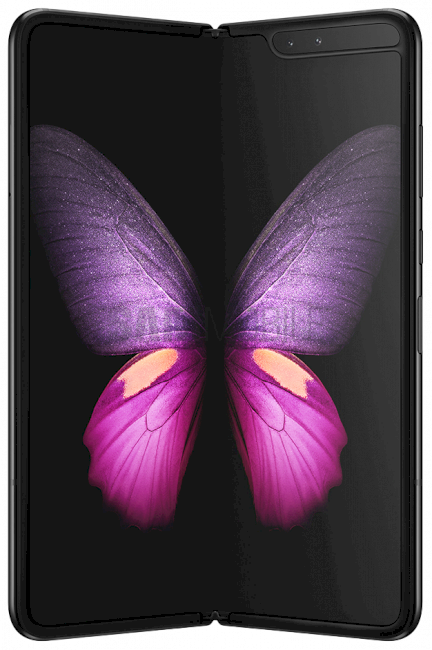
The Galaxy Fold could go on sale in more European markets by October 18, according to information we’ve received from our sources. Samsung’s foldable phone, as one would expect, first went on sale in the company’s home country, and it then made its way to Europe with a release in Germany, France, and the UK on September 18th. Samsung didn’t reveal the full list of European countries where the Fold would be available, nor did it say when the device will go on sale in those markets, but we’re told that it should hit Poland at the very least on October 18th.
And we are assuming Samsung will also release the Galaxy Fold in other European markets around the same time. The second to last of October is also when the Galaxy Fold will reach consumers in India – Samsung will start delivering Galaxy Fold orders in the country from October 20. Pre-orders in Poland and other European countries should begin a week or two before Samsung begins to ship devices to buyers, although there’s a chance October 18 may be the day the company starts taking pre-orders, as it is yet to list the Galaxy Fold on its Polish website.
Are you looking forward to buying the Galaxy Fold?
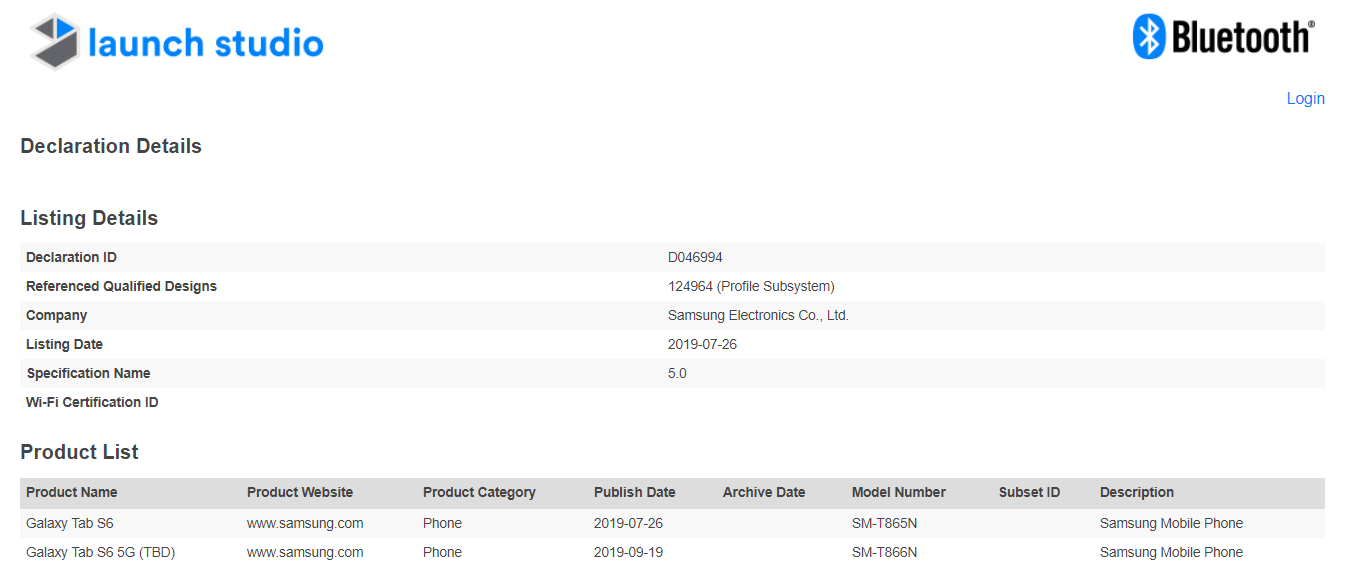
Samsung is preparing to launch its first 5G tablet, as evidenced by the emergence of the Galaxy Tab S6 5G with model number SM-T866N. For now, the release might be limited to South Korea.
Galaxy Tab S6 5G: World’s first commercial 5G tablet
So far in 2019, Samsung has launched a respectable number of 5G-capable devices, selling over two million Galaxy S10, Note 10, Galaxy A90 and Galaxy Fold units, in their respective 5G variants. Now it seems the company is preparing the launch of its first commercial 5G tablet, the Galaxy Tab S6 5G.
The guys over at GalaxyClub have uncovered a previously unknown Tab S6 variant carrying model number SM-T866N. This device was recently spotted at both the Wi-Fi Alliance and the Bluetooth SIG. While the first merely confirms the existence of the device, it is the second certification that reveals it is, in fact, a 5G-capable tablet.
Though further details remain scarce, it is safe to assume this Tab S6 5G will otherwise be the tablet we already reviewed some weeks ago. Of course, we do not know exactly when Samsung is planning to introduce the device. Still, usually these types of certifications are a good indication an official launch is not too far off.
For now, there is no indication of a release of the tablet outside of South Korea. European or US models have not yet surfaced. However, it is safe to say some 5G-enabled Galaxy tablet will sooner or later make it to those markets as well.
The Galaxy S10 lineup now has the ability to shoot Hyperlapse videos with the front camera. The Galaxy S10e/S10/S10+ received a major new update late last month that introduced a boatload of Galaxy Note 10 features, many of which are camera-related, and the addition of a Hyperlapse mode to the front camera is one of those features.
While Hyperlapse selfie videos are nothing new, it’s always good to have such functionality built into a smartphone’s camera app so users don’t have to opt for third-party solutions. Hyperlapse mode for the front camera works exactly like it does for the rear camera – you get the option to change the speed at which a Hyperlapse video is played back, and you can also leave it to the default auto setting and let the camera decide the playback speed.
Here is a small Hyperlapse video we captured with the front-facing camera on a Galaxy S10+:
Now, if you’re wondering when your Galaxy S10 will receive that awesome new update so you can start taking Hyperlapse videos of yourself, we don’t really have an answer. Samsung started the update’s rollout with Europe and has slowly been expanding its availability to more markets, and you will just have to be patient and wait until the update goes live in your country. The expansion has been slower than usual compared to previous feature updates for the Galaxy S10 lineup, and we can only assume Samsung is making sure no bugs get through before making it available for every Galaxy S10 owner across the globe.
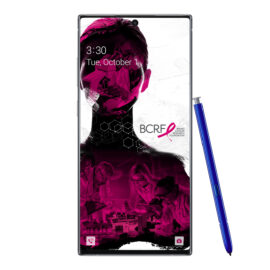
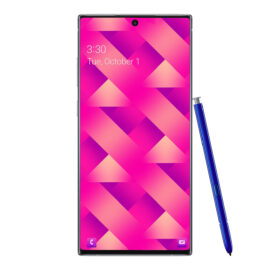
It’s the first day of October, which happens to be the Breast Cancer Awareness Month, and Samsung fans can now show their support by purchasing two brand new Breast Cancer Research Foundation (BCRF) Galaxy Themes for their smartphones. Each theme costs $2.99, and Samsung claims that 100 percent of the purchase price (up to $100,000) will be directed towards funding critical breast cancer research.
The BCRF Galaxy Themes are US-bound
The new BCRF themes are available only on the Galaxy Theme in the US. The themes are quite dissimilar in design and aim to portray the fight against cancer in different ways. One of the themes is based on an interweaving pattern inspired by the breast cancer awareness ribbon. The other theme is a collection of stylized images of researchers; a tribute to more than 14 million hours spent in researching a cure for cancer.
This unique opportunity allows Samsung smartphone owners to make a contribution to lifesaving research. There are more than 3.5 million breast cancer survivors in the US and deaths have fallen by 40 percent over the past 26 years. The BCRF is the highest-rated breast cancer organization in the country. It engages the brightest minds in science and medicine, supporting them with grants to pursue their research.
Along with the two new Galaxy Themes, Samsung is also bringing new content to the Discovery tab in Samsung Health, including tips for breast cancer prevention. Once again, this content themed around the Breast Cancer Awareness Month is not available in Samsung Health for Galaxy smartphone users outside of the United States.
The Galaxy Fold has been put through another durability test, this time by San Francisco-based extended warranty service provider, SquareTrade. The company drop-tested the device, but also came up with a way to test Samsung’s claims on the Fold’s hinge durability. SquareTrade used its own robot to fold and unfold the phone 120,000 times and concluded – rather unsurprisingly – that the Galaxy Fold is quite a fragile beast.
Galaxy Fold hinge put to the test
About six months ago, Samsung released a video showcasing the Galaxy Fold’s testing procedure for the complex mechanical hinge. The company used a series of robots to fold and unfold the phone repeatedly, claiming that the Galaxy Fold should be good for 200,000 folds. That meant it would be good for 100 folds per day for five years.
SquareTrade recently simulated Samsung’s testing methods using its robotic contraption and the redesigned Galaxy Fold. The company tested the durability of the hinge by folding and unfolding the device 120,000 times and the results don’t seem to quite match Samsung’s previous claims.
In its own testing environment, SquareTrade found that the Galaxy Fold developed a pixel blob after 18,500 folds. This blob appears similar to the screen defect that was reported recently. It may have something to do with the inherently fragile nature of the foldable display panel.
One false alarm and many folds later, the hinge test was concluded at 120,000 folds, or just about three years at 100 folds per day, with what SquareTrade describes as “deteriorated hinge action.” The company also drop-tested the phone from a height of 6 feet (1.83m) with unsurprisingly disastrous results for both the foldable screen and the cover display. Check out the video below for the full test.
At the end of the day, the hinge seems to be doing its job fine. In practice, the phone would have to be folded hundreds of times a day over several years to top a total of 120,000 folds, and it’s only fair to expect some wear after a while. More worrying is the blob on the flexible screen, mainly because the reasons why it develops aren’t very clear. Samsung is investigating the defect reported last week so we should know more about that eventually.
Have these results changed your opinion about the Galaxy Fold? Share your thoughts in the comment section below.
Samsung’s last smartphone manufacturing plant in China will be closing down at the end of the month, according to a recent report by Blogofmobile citing the Korean news outlet Chosun. Samsung’s Huizhou plant in the Guangdong province of China first fired up its conveyor belts in December 1992. Earlier this summer, Samsung decided to cut production and jobs at the Huizhou plant, signaling what will come to pass if the company’s influence in China will maintain its declining trajectory.
This shouldn’t be the end of Galaxy phones made in China
Samsung will continue to manufacture smartphones in its factories located in other countries including Vietnam and India. But as readers might be aware, Samsung has also been testing the waters with ODM devices manufactured under license by Chinese companies. Samsung’s first two ODM devices – the Galaxy A6s and Galaxy A10s – have not been assembled in Samsung’s facilities, and we assume the closing down of the Haizhou plant won’t have any effect on how future ODM phones wearing the Samsung badge will be developed in China. In fact, earlier estimates suggest the company could ship up to 40 million ODM phones manufactured in China by the end of the year.
One of the more obvious reasons behind Samsung’s decision to shut down its last-standing smartphone manufacturing plant in China could be attributed to the company failing to make a dent into the local smartphone market. Time will tell how the climate will continue to shift and whether or not Samsung will eventually have reasons to make a return to manufacturing phones in China. Until then, the company’s focus will shift to its factories located in other countries.
We publish a lot of stories on a daily basis. Unfortunately, the majority of news breaks during our European hours of operation, which makes it difficult for our readers in the US (and other regions) to keep up. However, we think we’ve come up with a fantastic solution — a daily recap.