الأربعاء، 27 يناير 2021

Samsung Electro-Mechanics reports astonishing profitability surge in Q4

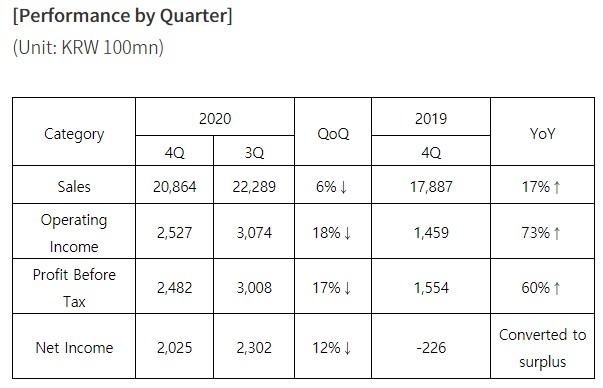
Samsung Electro-Mechanics just wrapped up another quarter of absolutely stellar business results. As best illustrated by the company itself, thanks to its newly published financials detailing the fourth quarter of 2020. Namely, the lesser-known sister company of Samsung Electronics reported the equivalents of about $1.88 billion in revenue and $228 million in operating income over the previous three months.

Compared to the same period last year, sales increased by 17%, while operating income surged a whopping 73%. For the whole year, Samsung Electro-Mechanics reported roughly $7.43 billion in sales, up 6% annually. At the same time, pre-tax earnings rose by about 12% year-over-year, finishing in the ballpark of $750 million.

Can 5G continue fueling Samsung’s remarkable growth?

How did Samsung Electro-Mechanics manage to end 2020 on such a high note? The short answer is “5G”. Because Samsung EM is still primarily a manufacturer of various electronic components used in countless consumer-ready goods. And as far as the newly concluded quarter goes, the consistent growth of the global market for 5G smartphones allowed it to move a lot more cutting-edge tech designed for premium integrated circuitry than it usually would. Multi-layer ceramic capacitors (MLCC) were a particularly lucrative business during the quarter, the company said.

With 5G being a key factor contributing to this remarkable quarter, it should come as no surprise that Samsung Electro-Mechanics does not appear to be as fixated on the idea of selling its wireless division as it was until just several weeks ago. In the meantime, the conglomerate’s flagship unit, Samsung Electronics, is scheduled to release its latest financials tomorrow.

The post Samsung Electro-Mechanics reports astonishing profitability surge in Q4 appeared first on SamMobile.


from SamMobile https://ift.tt/3cghDbu
via IFTTT

Samsung wins massive chip contract from its largest chipmaking rival

You know what they say: if you can’t beat them, win a few of their lucrative contracts covering massive volumes of cutting-edge silicon. OK, that might not ring a bell to everyone, but it certainly rang true to the person leading Samsung Foundry’s recent procurement talks with Intel. Because Intel’s largest rival in the chipmaking sphere just became one of its major chip suppliers, according to newly emerged reports out of South Korea.

Despite the somewhat unusual situation, Samsung’s achievement might not seem this impressive for long. As a number of reports from the past few weeks suggested Intel is also looking to offload some of its surplus production to TSMC, another one of its major rivals among silicon manufacturers.

Unusual or not, would this arrangement even change anything?

Today’s report mentions TSMC’s involvement, as well, with insiders claiming Intel opted to adopt a dual-vendor strategy for its next range of 14nm CPUs. This would be a so-called consignment manufacturing agreement, sometimes referred to as partial outsourcing.

While the details of the agreement between the two industry behemoths are still scarce, one figure that’s been floated around is the alleged size of Intel’s initial outsourcing order – 15,000 wafers per month. Assuming the new report is legitimate, this batch would undoubtedly be produced at Samsung’s existing 300nm plant in Austin, Texas. And yet the bottom line is that even had Intel completely ditched TSMC in favor of Samsung, the overall balance of powers in this tech segment would have probably remained the same.

In the meantime, TSMC is dashing ahead with the construction of its 5nm Arizona plant expected to begin operating in 2023. Samsung isn’t sitting idly, either, with last week’s reports alleging it’s fast-tracking plans for the construction of yet another foundry facility next to its existing Texas campus. And given the timing of its growing ambitions in the region, Samsung might very well ally with the newly inaugurated Biden administration before all is said and done.

The post Samsung wins massive chip contract from its largest chipmaking rival appeared first on SamMobile.


from SamMobile https://ift.tt/2YoPRRX
via IFTTT

الثلاثاء، 26 يناير 2021

Samsung silently introduces Galaxy A02 with a 5,000mAh battery

We had reported yesterday that Samsung could soon launch one more budget smartphone, the Galaxy A02. Today, the South Korean tech giant unveiled the Galaxy A02 in Thailand. The smartphone was silently listed on Samsung Thailand’s website, revealing all the features and specifications of the device.

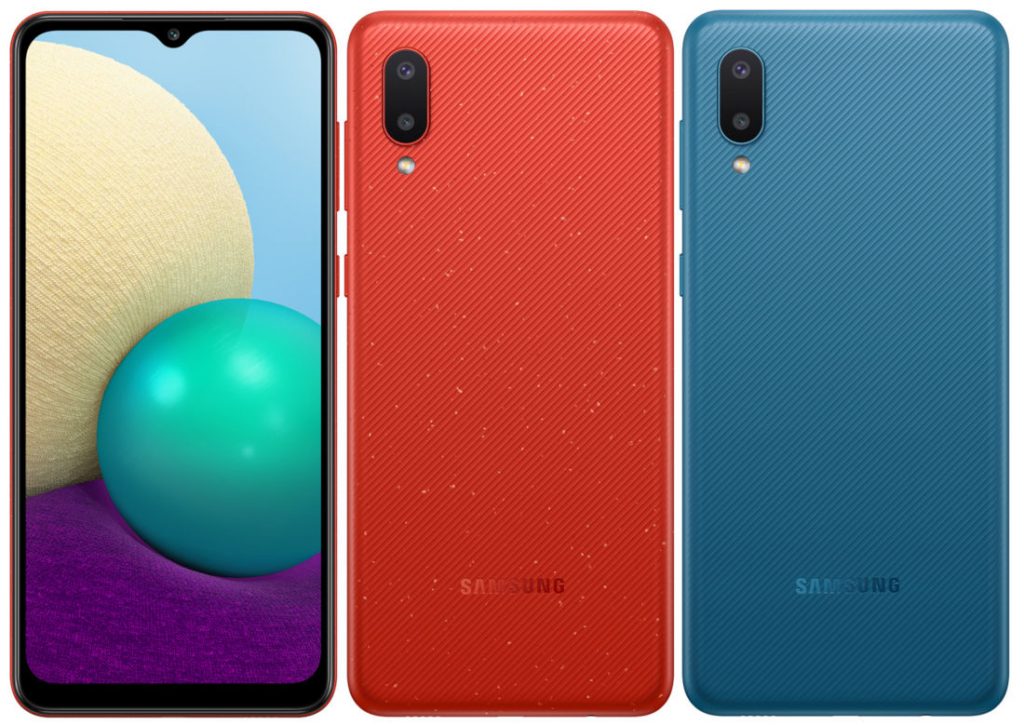
The Galaxy A02 has a large, 6.5-inch Infinity-V display that uses a PLS TF LCD panel with HD+ resolution. It comes in four colors: Denim Black, Denim Blue, Denim Gray, and Denim Red. The phone is equipped with the MediaTek MT6739W quad-core processor (with PowerVR Rogue GE8100 GPU), 2/3GB RAM, and 32GB/64GB internal storage. It also features a microSD card slot for storage expansion (up to 1TB) and a dedicated dual-SIM card slot.

At the rear, the Galaxy A02 features a 13MP+2MP dual-camera setup and an LED flash. The 2MP camera has a macro lens for close-up shots. The phone can record Full HD (1080p) videos at 30fps. At the front, the entry-level smartphone features a 5MP selfie camera with an F2.0 aperture. Sadly, the phone runs Android 10 (with One UI 2), which is more than a year old. The phone has LTE, GPS, Wi-Fi b/g/n, Bluetooth 5.0, headphone jack, a microUSB port, and a 5,000mAh battery with 7.75W charging.

Samsung hasn’t unveiled the Galaxy A02’s availability yet, but its price is THB 2,999 (around $99.99) in Thailand. We expect the entry-level device to make it to more markets soon.

Samsung Galaxy A02 Blue Red

The post Samsung silently introduces Galaxy A02 with a 5,000mAh battery appeared first on SamMobile.


from SamMobile https://ift.tt/2M70iqY
via IFTTT

How much does that cheap Galaxy S21 price actually cost us?

With the Galaxy S21, Samsung is releasing its cheapest full-fledged Android flagship in years. And despite some high-level operational (re)thinking that’s going on at the moment in Seoul, Samsung verifiably doesn’t want to be in the business of making less money than it previously did. Another certainty is that the global smartphone market is extremely saturated, and its premium segment doubly so. Meaning that for this device to be as affordable as it is, some compromises had to have been made.

So, how much does this relatively cheap price of the Galaxy S21 actually cost us? Assuming it’s even us, the consumers, who are the ones shouldering the difference indirectly? That’s what aim to find out, and we’ll also be taking a closer look at the Galaxy S21+ and Galaxy S21 Ultra. Because the other two-thirds of the high-end mobile range is getting the same generational discount as the entry-level model.

Is a $200 price cut really that big of a deal?

But first, our reference point: the Galaxy S20 series released globally in early 2020 with an introductory price of $999. Not even ten months later, the Galaxy S21 line is scheduled to hit digital and physical store shelves with a 20% lower starting point – $799.

Given Samsung’s track record, a $200 price cut right off the bat is a pretty big anomaly. Not that such a move wasn’t overdue. After all, we have just witnessed the end of a prolonged flagship price creep period spanning multiple years. And yet this much more affordable entry point might not be coming out of Samsung’s profit margins.

Over the past decade, the company typically introduced a new Galaxy S generation along with a price hike. The price remained unchanged compared to the previous year only twice, which was the case with the Galaxy S5 and Galaxy S6. And prior to this year’s 20% cut, Samsung slashed the lineup’s entry price just once, as the Galaxy S9 range debuted in 2018 at $719, a whole 4% ($30) cheaper than the Galaxy S8 family.

To answer the above: yes, a $200 price decrease within less than a year is a pretty big deal for Samsung’s staple smartphone series.

Can one charger and a pair of headphones account for a $200-shaped hole?

Of course, this is the first Galaxy S generation that will be sold without a complimentary pair of headphones or a charging adapter. The official story is that Samsung is becoming a more environmentally friendly business. Unofficially, it’s getting rid of both accessories simply because Apple already demonstrated it can get away with such a move. That turn of events might be unfortunate from a consumer perspective, but it’s nowhere near enough to account for $200 worth of difference.

Mind you, Samsung isn’t claiming otherwise, as evidenced by the fact you can already buy an official Galaxy S21 charger for just $20. It’s hence safe to say manufacturing this accessory costs Samsung (way) less than $20. Ditto for the omitted pair of USB-C headphones from AKG; you can still buy a replacement pair of earbuds bundled along with the Galaxy Note 20 and Galaxy S20 at an identical price point.

Are there significant hardware differences (or even downgrades) across the last two Galaxy S generations?

Much like last year’s line, the Galaxy S21, Galaxy S21+, and the Galaxy S21 Ultra all use the same system-on-chip. Well, the same two, depending on the market, between the Exynos 2100 and Snapdragon 888. Beyond that is where we start seeing significant differences – if not outright downgrades – across the two product generations.

E.g., only the flagship model will offer a hardware upgrade in the camera department, whereas the other two will be identical to their predecessors, photography-wise. And only the Galaxy S21 Ultra will feature a WQHD+ (1,440 x 3,200) display, whereas the 6.2-inch Galaxy S20 and 6.7-inch Galaxy S20+ will both peak at an FHD+ resolution of 1,080 by 2,400 pixels. Given how mobile VR failed to take off, this fidelity downgrade might not seem significant in 2021, and yet it arguably lowers Samsung’s production costs by around $30 per unit, based on past bill of materials estimates.

The good news is that the Galaxy S21 and Galaxy S21+ at least offer an adaptive refresh rate amounting to 48-120Hz. And given how last year’s devices weren’t able to push past 60Hz at resolutions above FHD+, this difference shouldn’t be that obvious if you’re upgrading from something like the Galaxy S20+. But the Galaxy S21 Ultra is still superior in this regard, seeing how its higher-resolution display covers an even wider adaptive range – from 10Hz to 120Hz.

Speaking of display features that probably won’t be missed but help explain the massive price decrease across the last two Galaxy S generations, the two more affordable members of the new family both feature completely flat screens. This leaves the Galaxy S21 Ultra as the sole remaining champion of Samsung’s curved display technology.

A potentially more controversial difference hides behind the entry-level Galaxy S21. Namely, this particular smartphone features a plastic back, unlike its two peers (and dozens of direct predecessors) which utilize a glass rear panel. Not that high-quality plastic doesn’t offer some advantages over glass, but it’s certainly cheaper to manufacture, and the general consensus is that it doesn’t feel as premium in hand.

Then there’s the fact that the entire Galaxy S21 range will be missing out on MST tech in certain countries. And the shorter end of this stick doesn’t just include the largest, most valuable smartphone market on the planet (the U.S.), but also the fastest-growing one (India). Up until today, the Magnetic Secure Transmission standard was arguably the main thing shielding Samsung Pay users from a horribly disjointed and inconsistent contactless payment experience (so, Apple Pay, basically). Only time will tell whether it’s too early for Samsung to be ditching this stop-gap solution that worked with any old Point-of-Sale terminal equipped with a magnetic strip, unlike NFC. Whatever the case might be, UWB tech could feasibly replace both just a few years down the line.

Last but not least, the Galaxy S21 series also lacks a microSD card slot across the board. This isn’t the first time Samsung cut expandable storage from its premium flagship range, so fingers crossed we get it back eventually – or immediately, like the last time this happened.

So, there you have it: Between last year’s cameras, a lower-resolution display lacking in curvature, no MST support in major markets, no expandable storage at all, no headphones, no charger, and no plastic back, the entry-level Galaxy S21 isn’t so much of a discounted follow-up but a sidegrade to the Galaxy S20. The Galaxy S21 Ultra, on the other hand…

  • Model: SM-G991B
  • Dimensions: Bar: 151.7 x 71.2 x 7.9 mm
  • Display: 6.2 inch / 157.48 mm Dynamic AMOLED 2X
  • CPU: Exynos 2100
  • Camera: 12MP
  • Model: SM-G996B
  • Dimensions: Bar: 161.5 x 75.6 x 7.8 mm
  • Display: 6.7 inch / 170.18 mm Dynamic AMOLED 2X
  • CPU: Exynos 2100
  • Camera: 12MP
  • Model: SM-G998B
  • Dimensions: Bar: 165.1 x 75.6 x 8.9 mm
  • Display: 6.8 inch / 172.72 mm Dynamic AMOLED 2X
  • CPU: Exynos 2100
  • Camera: 12MP

The post How much does that cheap Galaxy S21 price actually cost us? appeared first on SamMobile.


from SamMobile https://ift.tt/2NFaPKt
via IFTTT

Samsung might soon launch Galaxy A72 mid-range smartphone

Samsung might soon launch the Galaxy A52 and the Galaxy A72 as the phones have received the required certifications. The company is working on 4G and 5G variants of its upcoming mid-range smartphones, and the two devices have been leaked already. Now, Samsung has created a support page for the 4G variant of the Galaxy A72 on its website.

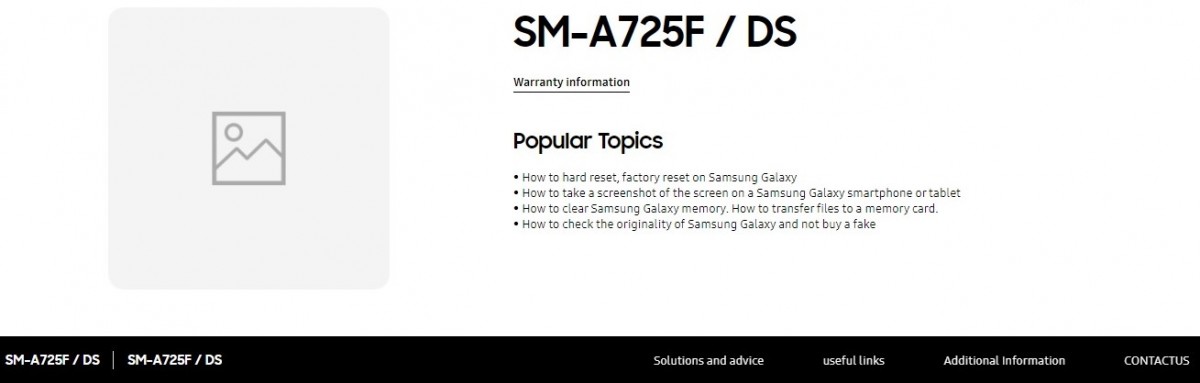
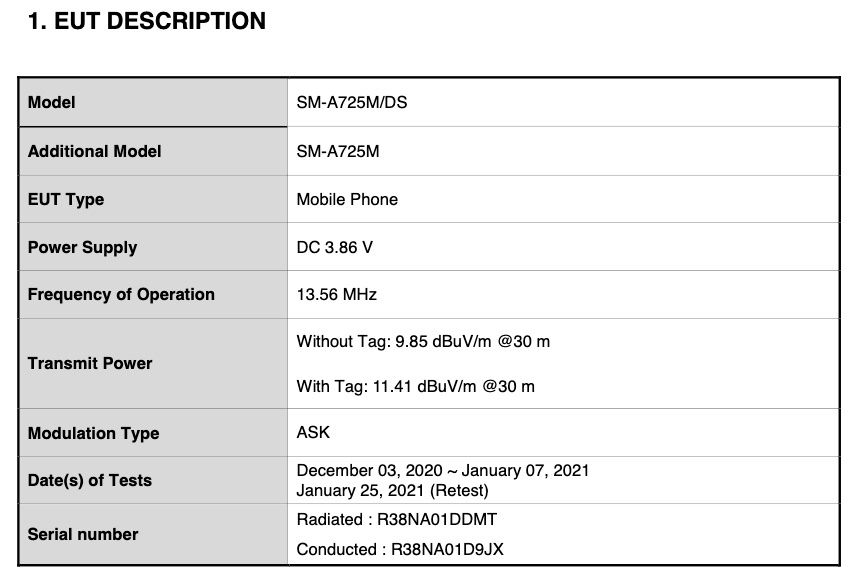
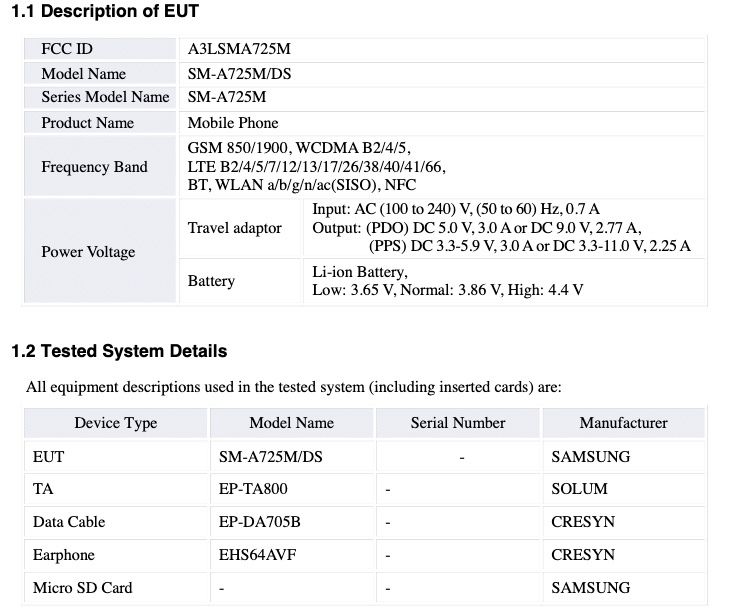
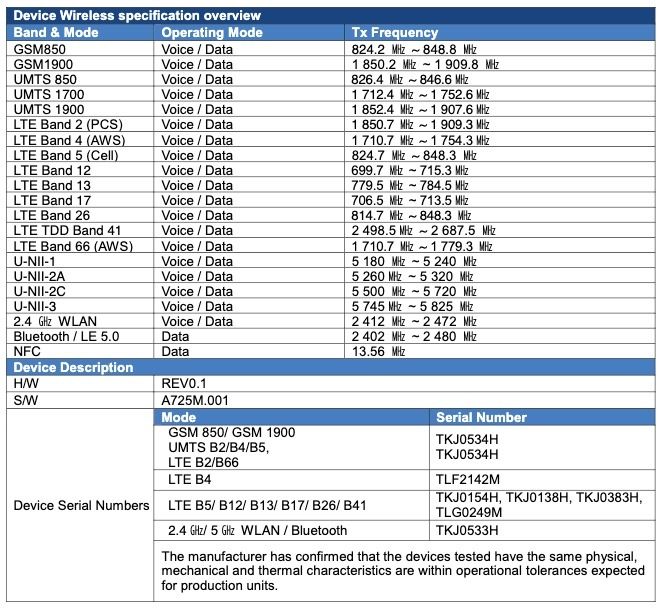
The Galaxy A72 4G’s (SM-A725F/DS) support webpage went live on Samsung Russia’s website, clearly hinting towards the phone’s imminent launch. The device has even received the FCC certification, revealing its connectivity and charging features. The Galaxy A72 4G features a dual-SIM card slot, 4G LTE (Bands 2/4/5/7/12/13/17/26/38/40/41/66), dual-band Wi-Fi b/g/n/ac, Bluetooth, and NFC. It also supports up to 25W fast charging, and could come bundled with Samsung’s 25W USB-PD charger EP-TA800.

It looks like Samsung will use a Snapdragon processor in both 4G and 5G variants of the Galaxy A72. The Galaxy A72 4G will feature the Snapdragon 720G processor, while the 5G variant will be equipped with the Snapdragon 750G processor. The phone could come with 6GB/8GB RAM, 128GB/256GB internal storage, a quad-camera (64MP+12MP+5MP+5MP) setup at the rear.

The Galaxy A72’s design was leaked last month, revealing its 6.7-inch Infinity-O display, a USB Type-C port, and a headphone jack. It could also feature an in-display fingerprint reader and will come with Android 11 pre-installed. The phone will reportedly be launched in four colors: black, blue, violet, and white.

Samsung Galaxy A72 4G Support Page On Samsung Russia Website


Samsung Galaxy A72 4G FCC Certification - 02

Samsung Galaxy A72 4G FCC Certification - 01

Samsung Galaxy A72 4G FCC Certification - 03

The post Samsung might soon launch Galaxy A72 mid-range smartphone appeared first on SamMobile.


from SamMobile https://ift.tt/2YjBsqs
via IFTTT

Samsung is rolling out the 2nd Galaxy S21 pre-release firmware update

Samsung has released another firmware update for the Galaxy S21 series. Indeed, the new flagship trio has yet to reach customers but the company has already rolled out a first firmware update in anticipation of the phone’s imminent market release, while a second rollout is now taking place for the Galaxy S21 lineup in countless regions.

Given that the Galaxy S21 series has yet to hit the market, details on the second update’s changelog are nonexistent but we can take an educated guess and assume that both firmware updates that got released so far are meant to iron out any kinks left behind during the Galaxy S21 / One UI 3.1 development process.

The Galaxy S21 flagship trio is available for pre-order and it will start shipping to customers later this week on January 29. The lineup runs Android 11 and One UI 3.1, and the firmware is virtually complete, though there are a few bugs that need to be addressed. SmartThings, for example, doesn’t seem to be working all that well on the Galaxy S21 Ultra running pre-release firmware, leading to massive battery life losses.

While it’s unclear what changes the new firmware update has introduced to the Galaxy S21 series, the new firmware (versions G99xBXXU1AUAC) will be waiting for customers upon unboxing the phones, assuming an even newer update won’t be released by Samsung before then. And if you’re looking to download the latest Galaxy S21 firmware files whenever they roll out, you can refer to our firmware archive via the links below.

  • Model: SM-G991B
  • Dimensions: Bar: 151.7 x 71.2 x 7.9 mm
  • Display: 6.2 inch / 157.48 mm Dynamic AMOLED 2X
  • CPU: Exynos 2100
  • Camera: 12MP

  • Model: SM-G996B
  • Dimensions: Bar: 161.5 x 75.6 x 7.8 mm
  • Display: 6.7 inch / 170.18 mm Dynamic AMOLED 2X
  • CPU: Exynos 2100
  • Camera: 12MP

  • Model: SM-G998B
  • Dimensions: Bar: 165.1 x 75.6 x 8.9 mm
  • Display: 6.8 inch / 172.72 mm Dynamic AMOLED 2X
  • CPU: Exynos 2100
  • Camera: 12MP

The post Samsung is rolling out the 2nd Galaxy S21 pre-release firmware update appeared first on SamMobile.


from SamMobile https://ift.tt/36cMDFu
via IFTTT

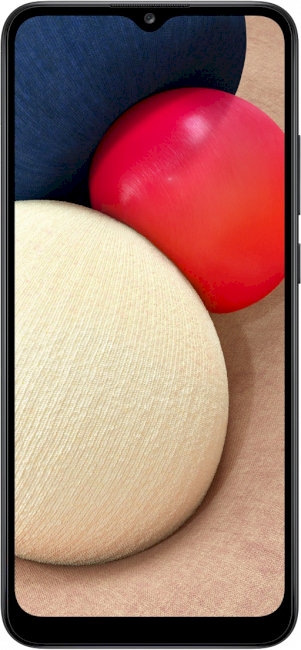
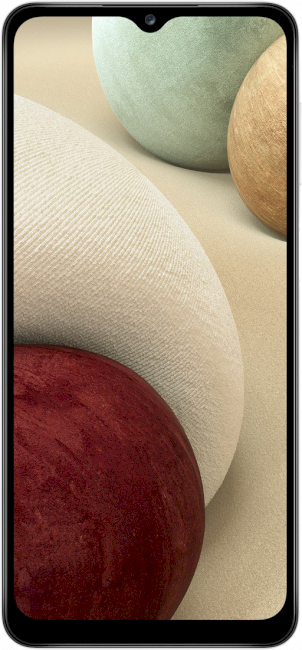
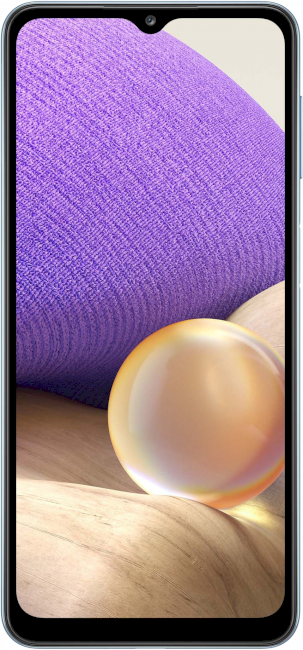
Galaxy A02s vs A12 vs A32 5G: An epic three-sided battle on a budget

Samsung’s three new Galaxy A budget phones for 2021 were revealed over the past few weeks and they’re known as the Galaxy A02s, the Galaxy A12, and the Galaxy A32 5G. They cater to slightly different audiences but they all have at least one thing in common: they’re budget offerings that won’t break your bank as long as there’s at least €200-€300 in it.

Samsung fans who are familiar with the company’s naming scheme already know that the Galaxy A32 5G is the more powerful device of the three, and therefore it costs more. The Galaxy A02s is the cheapest entry on this list, while the Galaxy A12 meets them in the middle. But how do the Galaxy A02s, the Galaxy A12, and the Galaxy A32 5G compare side-by-side and how exactly do their pricing differences translate to hardware? Let’s have a look.

Galaxy A02s vs Galaxy A12 vs Galaxy A32 5G: Processing power

The more money you’re willing to spend on your budget phone, the faster it will be. This might not always be entirely true but it it’s very much so for Samsung’s new Galaxy A trio. The Dimensity 720 5G chipset that’s used by the Galaxy A32 5G is more powerful than the MediaTek Helio P35 SoC, and in turn, the latter outperforms the Snapdragon 450 SoC beating at the heart of the Galaxy A02s.

More detailed CPU and GPU specifications can be found in the table below but what it all means in practice is that the Galaxy A32 5G is a better-suited phone for mobile gaming compared to the Galaxy A02s, the latter of which will struggle more with demanding 3D titles. Thankfully the performance gap is narrower or a lot less noticeable with simpler tasks such as browsing social media or streaming videos, so as long as mobile gaming isn’t a priority, all three devices offer decent performance levels.

The same ‘more money, more power’ paradigm is equally valid in regards to memory options, wherein the Galaxy A32 5G offers the highest RAM capacity of all at 8GB (as well as 6GB and 4GB). But surprisingly enough, all three phones drive virtually the same display.

The Galaxy A02s, A012, and A32 5G have identical display specs

Despite their internal hardware differences, all three models have pretty much the same display specs. They are equipped with 6.5-inch IPS panels with a pixel count of 1600 by 720 and a pixel density of roughly 270 pixels per inch.

These displays are obviously limited to a refresh rate of 60Hz and all three have a fairly thick ‘chin’ as well as the signature Infinity-V display notch that makes room for the selfie camera.

Galaxy A02s vs Galaxy A12 vs Galaxy A32 5G: Camera

Simply enough, the Galaxy A32 5G has the more complete camera setup, boasting a 48MP main sensor with Phase Detection autofocus, an 8MP ultra-wide shooter, a 5MP macro camera and a 2MP depth sensor. The selfie camera has a 13MP resolution.

The Galaxy A12 is the second-most capable camera smartphone on the list thanks to a 48MP main sensor, a 5MP ultra-wide, two additional 2MP depth and macro cameras, and an 8MP selfie camera.

Last and most certainly least impressive, the Galaxy A02s carries a triple camera setup comprising a 13MP main shooter, a 2MP macro, and a 2MP depth sensor. The selfie camera clocks in at a resolution of 5MP.

Galaxy A02s vs Galaxy A12 vs Galaxy A32 5G: Design

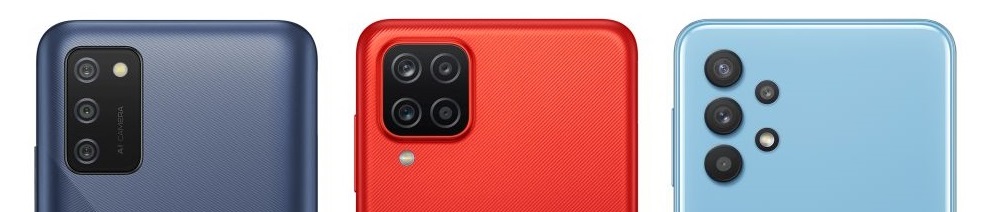
While all three phones look nearly identical from the front, their back panels add a lot more character and personality. Each phone has a unique camera design and the dissimilarities are striking. The Galaxy A02s has a rectangular camera housing while the Galaxy A12’s is square-shaped. Meanwhile, the Galaxy A32 5G does away with the concept of the camera housing altogether.

The Galaxy A12 and its more expensive sibling have a side-mounted fingerprint sensor but the Galaxy A02s lacks this biometric authentication method altogether. The three smartphones are also almost equally-sized and they each tip the scales at around 200 grams.

Galaxy A02s vs Galaxy A12 vs Galaxy A32 5G: Other features and pricing

A few other characteristics that are shared between all three models are the 5,000mAh battery with 15W charging, the inclusion of a USB-C and 3.5mm headphone jack, and the expandable storage option. But having been unveiled later than the other two models, the Galaxy A32 5G benefits from Android 11 and One UI 3.0 out of the box.

Both the Galaxy A32 5G and the Galaxy A12 have NFC capabilities and Bluetooth 5.0 connectivity, whereas the Galaxy A02s lacks NFC and supports Bluetooth 4.2. And, of course, the Galaxy A32 is the only model of the three to take advantage of 5G connectivity.

The final piece of the puzzle is the cost of acquiring these phones, and you’ll be glad to hear that all three models are priced competitively. The Galaxy A02s and the Galaxy A12 generally cost €150 and €179, respectively, whereas the Galaxy A32 5G is expected to hit the market in the coming weeks for under €300.

If you want to determine which of these budget phones deserves your hard-earned cash and you’re looking for more technical details, you can refer to our device comparison widget below.

Galaxy A02s
VS.
Galaxy A12
VS.
Galaxy A32 5G
General Information
Model name Galaxy A02s Galaxy A12 Galaxy A32 5G
Model number SM-A025F SM-A125F SM-A326B
Model type Bar Bar Bar
Color Black (Black)
White (White)
Blue (Blue)
Black (Black)
White (White)
Red (Red)
Black (Black)
White (White)
Blue (Blue)
Violet (Violet)
Announced 2020, November 2020, November 2021, January
Released 2020, November 2020, November
Physical Specifications
Dimensions Bar: x x mm Bar: 164 x 75.8 x 8.9 mm Bar: 164.2 x 76.1 x 9.1 mm
Weights g 205g 205g
Operating System
Operating system
One UI version
Network
Networks 2G
3G
4G
2G
3G
4G
2G
3G
4G
5G
Display
Kind Main Display Main Display Main Display
Name Infinity-V Display Infinity-V Display Infinity-V Display
Technology PLS TFT LCD PLS TFT LCD IPS LCD
Size 6.5 inch / 165.1 mm 6.5 inch / 165.1 mm 6.5 inch / 165.1 mm
Resolution HD+ / x pixels HD+ / x pixels HD+ / 1600x720 pixels
Pixel density PPI PPI 270 PPI
Screen to body ratio % % ~81.6%
Memory
RAM/ROM sizes 3 GB RAM with 32 GB ROM 3 GB RAM with 32 MB ROM
4 GB RAM with 64 GB ROM
6 GB RAM with 128 GB ROM
4 GB RAM with 128 GB ROM
6 GB RAM with 128 GB ROM
8 GB RAM with 128 GB ROM
Rear camera
Megapixels 13MP 48MP 48MP
Aperture F2.0 F1.8
Battery
Standard battery capacity 5000 mAh 5000 mAh 5000 mAh

The post Galaxy A02s vs A12 vs A32 5G: An epic three-sided battle on a budget appeared first on SamMobile.


from SamMobile https://ift.tt/36ctFig
via IFTTT

جميع الحقوق محفوظة لمدونة الغريب 2013