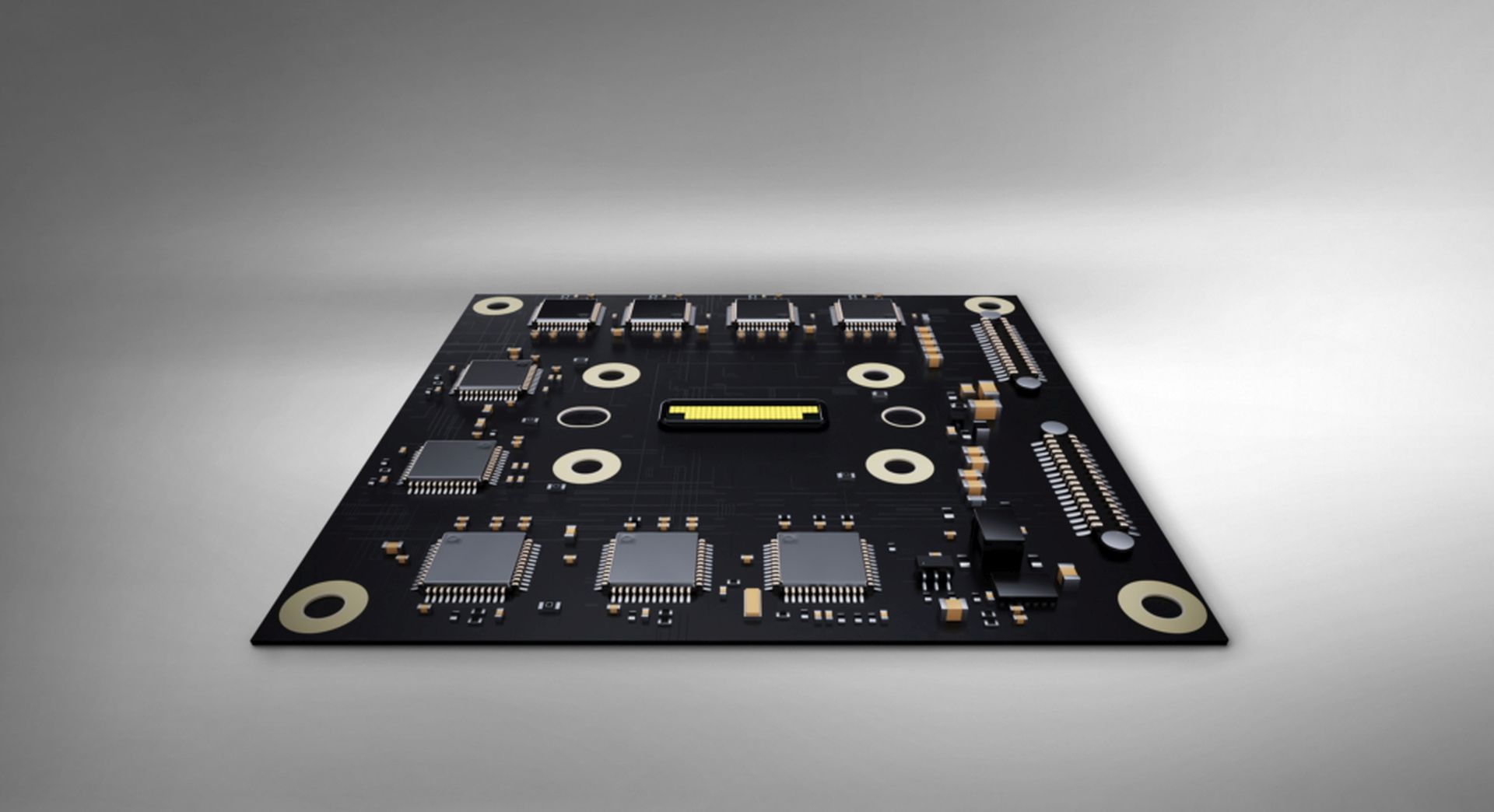
الخميس، 15 أبريل 2021

Samsung launches Galaxy SmartTag+ in South Korea

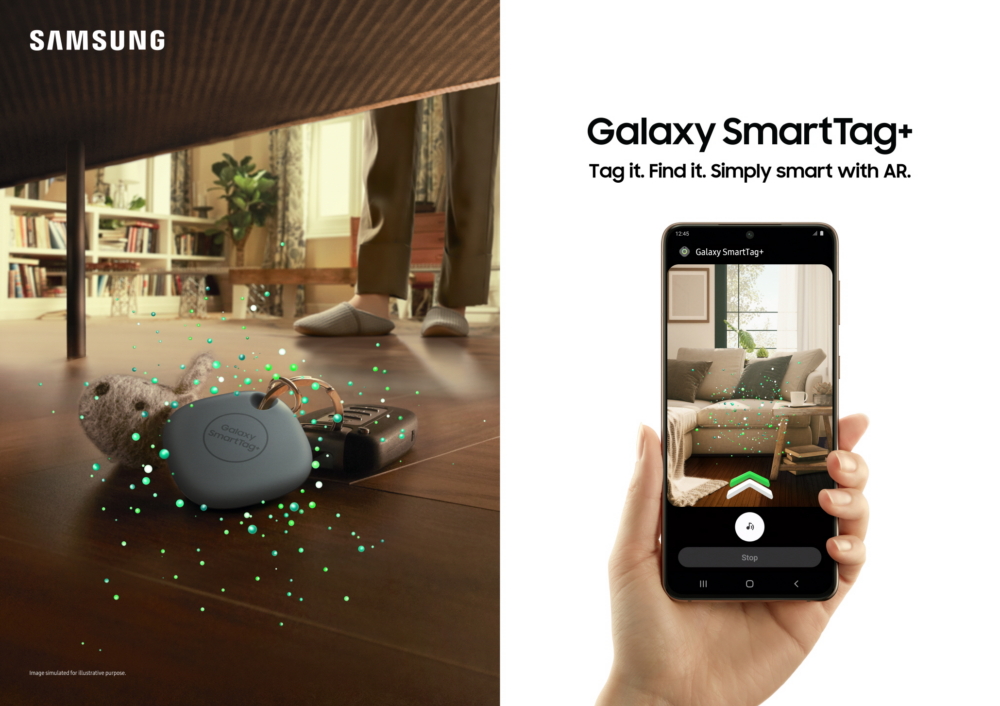
Samsung had unveiled two new object trackers—Galaxy SmartTag and Galaxy SmartTag+—alongside the Galaxy S21 series earlier this year. While the entry-level Galaxy SmartTag became available for purchase immediately, the Galaxy SmartTag+ was recently launched in the US. Now, the company has announced that it has launched the Galaxy SmartTag+ in South Korea.

The Galaxy SmartTag+ is priced at KRW 39,600 (around $35) in South Korea, and it will be available in two colors: Black and Denim Blue. The object tracker can be purchased via 11Street, Coupang, G Market, Naver Smart Home, and Samsung’s online and offline stores.

Samsung’s high-end object tracker is small and can be tied to an object via its lanyard port or stuck via a sticker. It features a loud ringer, a multi-function button, and a removable battery. It is IP53 certified for dust and water splash resistance. Apart from Bluetooth 5.0 LE, the Galaxy SmartTag+ also features UWB (Ultra-Wideband) for greater accuracy while finding the device. The Galaxy SmartTag+ is only compatible with Galaxy smartphones and tablets, and it works with SmartThings.

Using the SmartThings Find service, you can find the SmartTag+ easily via the AR mode. Customers can also opt to let other Galaxy users find their SmartTag+ if the tracker isn’t in the range of their smartphone. The data in SmartThings Find is completely encrypted, so only you can see its location. The button on the device can be used to control smart home products.

Samsung Galaxy SmartTag+ SmartThings Find AR

The post Samsung launches Galaxy SmartTag+ in South Korea appeared first on SamMobile.


from SamMobile https://ift.tt/2ORfvxE
via IFTTT

Quick Share is the best way of sharing files on Galaxy devices, here’s how to use it

Samsung almost always improves upon stock Android features. Be it scrolling screenshots, better screen recorder, UI customizations, a battery camera app, or a more functional image gallery app, the company always comes up with better features compared to Google.

Wireless file transfer is another such aspect that was better on Galaxy smartphones and tablets compared to stock Android, thanks to Samsung’s own customizations over Wi-Fi Direct. However, Samsung removed the Wi-Fi Direct file sharing feature, starting with Android 11-based One UI 3, and people are not happy with the company’s decision.

Wi-Fi Direct sharing on Galaxy devices allowed users to quickly share images, videos, documents, files, and more even without an internet connection or a Wi-Fi router. With the feature gone, Galaxy users have been quite vocal about its removal. While Galaxy smartphones and tablets running One UI 3 (or newer) can still receive files via Wi-Fi Direct (from devices running One UI 2.x or older), but they can’t send files to other devices.

However, users don’t need to worry too much about it as Samsung has brought a great replacement for Wi-Fi Direct: Quick Share.

What are the advantages of using Quick Share?

Quick Share is quite similar to Wi-Fi Direct and is easier to use. It can be used to share images, videos, documents, links, and any type of file with any Galaxy device. Quick Share is quite similar to Apple’s AirDrop feature, thanks to its effortless nature. Quick Share allows you to share anything to a device that has Quick Share turned on, all without going through unnecessary hoops like pairing devices together beforehand.

Quick Share is not only faster but also works when you are not connected to a Wi-Fi router or an internet connection. It is rumored that Quick Share will soon be launched for laptops, but it could be exclusive to Samsung’s laptop range.

How to use Quick Share to send files on Galaxy devices

Step 1: Open any image, video, document, file, or web link on your Galaxy smartphone or tablet and tap the Share button. You can even select multiple files from the Gallery app or the My Files app and then tap the Share button.

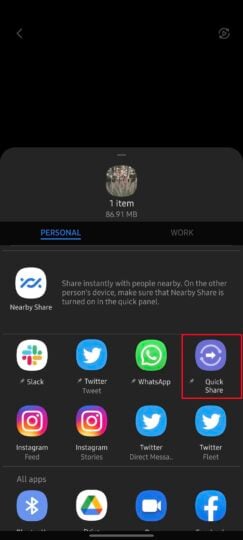
Samsung Quick Share - 01 How to use Samsung Quick Share

Step 2: Now tap Quick Share from the sharing menu.

Step 3: Select the Galaxy device with whom you want to share the file. The receiving device needs to be unlocked to be visible in the list. It also needs to have Quick Share turned on (to see how the receiving device can be ready to accept files through Quick Share, see the next section below).
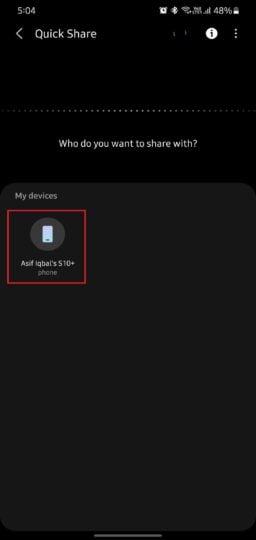
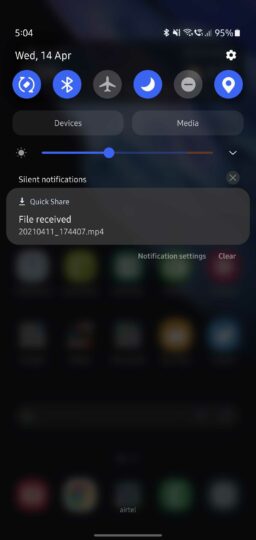
Samsung Quick Share - 04

Step 4: On the receiving device, you will see a pop-up prompt to Decline or Accept the file. Tap Accept to receive the file.

How to receive files via Quick Share on Galaxy devices

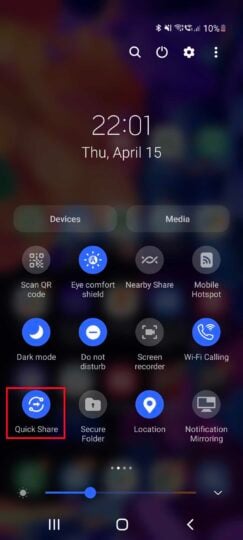
For receiving files over Quick Share from other devices, you simply need to have the Quick Share feature enabled on your phone (or tablet). It can be turned on using its toggle in the quick toggles area that you access by swiping down the notification shade twice. If you can’t see it, you may have to make the toggle visible in the quick toggles area by tapping the three-dot button and selecting Edit buttons.

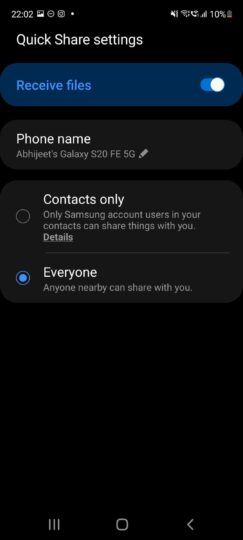
By default, only contacts that use a Samsung account and are saved on your device will be able to send data to you via Quick Share. To change that, see the steps below.

How to change Quick Share’s privacy settings on Galaxy devices

Quick Share lets you customize your privacy settings, like allowing everyone to discover your phone and send files or just your saved contacts, and changing the name of the device. Go through the following steps to change your privacy settings while sharing or receiving files using Quick Share:

Step 1: Swipe down on the notification shade to see all quick toggles and find the one that says Quick Share. If you can’t see it, you may have to make the Quick Share toggle visible by tapping the three-dot button and selecting Edit buttons.

Step 2: Long press the Quick Share button to go to its settings screen.
How to use Samsung Quick Share How to use Samsung Quick Share

Step 3: You can now choose between Contacts Only and Everyone. You can also change the name of your phone by tapping the pencil icon.

The post Quick Share is the best way of sharing files on Galaxy devices, here’s how to use it appeared first on SamMobile.


from SamMobile https://ift.tt/2Q8JG4b
via IFTTT

Galaxy Book Go bags another approval ahead of its imminent April launch

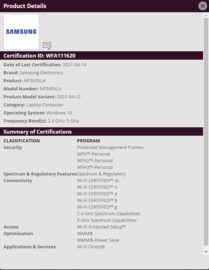
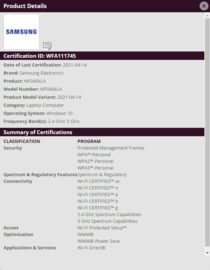
Just in case you need another confirmation that Samsung is preparing to launch its new line of Galaxy Book laptops, the Wi-Fi Alliance has recently approved two variants of the Galaxy Book Go. Same as when the laptop was approved by the FCC, the two variants carry model numbers NP340XLA and NP345XLA.

As expected, the Wi-Fi Alliance describes the product as a ‘Laptop Computer,’ though the final moniker isn’t mentioned anywhere. Specifications are also scarce but the regulatory body confirms that the notebook runs Windows 10.

At the end of the day, it doesn’t really matter if the WFA hasn’t revealed any technical details. They’ve already been uncovered weeks ago, but the WFA application further confirms that the Galaxy Book Go launch is just around the corner. After all, Samsung has already announced the unveiling date, so it’s only natural for the company to prepare the device for launch by gaining the necessary approvals.

Galaxy Book Go quick spec recap

The Galaxy Book Go will be revealed on April 28 alongside the Galaxy Book Pro and the Galaxy Book Pro 360. The Book Go is expected to be the only model of the three to feature a Snapdragon chipset, specifically the 8cx SoC. Meanwhile, the Book Pro and Book Pro 360 are expected to pack Intel’s 11th generation Core chipsets.

Other alleged specs for the lightweight model include 4GB/8GB LPDDR4X RAM, 128/256GB of built-in storage, dual-band Wi-Fi b/g/n/ac, Bluetooth 5.1 LTE, and a 14-inch FHD display. Prices remain unknown but we’re bound to find out more later this month at the upcoming Galaxy Unpacked virtual event.

The post Galaxy Book Go bags another approval ahead of its imminent April launch appeared first on SamMobile.


from SamMobile https://ift.tt/3uTCPu5
via IFTTT

Samsung may have decided to not launch the Galaxy Z Flip 2 this year

Samsung was expected to launch the Galaxy Z Flip 2 alongside the Galaxy S21 this year. It would have followed the same timeline as its predecessor. That did not happen. Subsequent reports suggested that the device would come in the second half of 2021.

Word on the street is that Samsung has decided not to launch the Galaxy Z Flip 2. That’s not to say it won’t be coming out with a new clamshell foldable, just that it won’t be called the Galaxy Z Flip 2.

There’s going to be a Galaxy Z Flip 3 instead

Citing several reliable sources, a new report claims that Samsung’s latest clamshell foldable will be called the Galaxy Z Flip 3 instead. It follows rumors about Samsung wanting to equalize the monikers for the Galaxy Z Fold and Galaxy Z Flip series.

Samsung has already launched two Galaxy Z Fold devices. The one due this year will ostensibly be called the Galaxy Z Fold 3. Samsung is reportedly going to launch both new 2021 foldables at the same time in July.

Unveiling a Galaxy Z Flip 2 alongside the Galaxy Z Fold 3 might end up being confusing for customers. They might feel that the Galaxy Z Flip 2 is an older model, primarily because of the number “2” compared to the Galaxy Z Fold 3. That’s not an impression Samsung would want to send out.

So it would take the easy way out and simply market the new clamshell foldable as the Galaxy Z Flip 3 instead of the Galaxy Z Flip 2. Whatever it ends up calling the device is irrelevant. What most people are looking forward to are the changes that it introduces with the device. I, for one, can’t wait to see it in the flesh.

The post Samsung may have decided to not launch the Galaxy Z Flip 2 this year appeared first on SamMobile.


from SamMobile https://ift.tt/32dZOUu
via IFTTT

Samsung develops world’s first ultra-small high-capacity MLCC for IT

Samsung Electro-Mechanics has just announced the world’s first ultra-small, high-capacity MLCC (multilayer ceramic capacitor) designed for a wide variety of IT applications. This new MLCC is different from the one that was introduced by the company at the beginning of the year, thought they’re both fit for 5G smartphones and other product categories such as home appliances and electric vehicles.

Compared to the previous 1209-size MLCC though, Samsung’s latest solution measures only 0.4 x 0.2mm, which means it’s several times smaller. The company claims that the new MLCC was developed as demand for ultra-small solutions grew with the emergence of 5G smartphones and more advanced multi-camera systems. Up until now, 0402-size capacitors were limited by their 4V voltage, however, Samsung’s latest solution is rated at 6.3V.

The purpose of a capacitor is to control the stable flow of electric current within an electronic circuit. Devices such as smartphones generally require more than 1,000 capacitors, which means that the size of each individual capacitor becomes very important when managing the internal space. Aside from the obvious size advantages, Samsung also claims that the new MLCC enhances stability and product life.

According to Samsung Electro-Mechanics head of Component Business Doo Young Kim, this product is the first within the industry to realize miniaturization, highest capacity, and high internal voltage. The executive added that the new MLCC will help Samsung Electro-Mechanics secure a leading position within the segment.

The post Samsung develops world’s first ultra-small high-capacity MLCC for IT appeared first on SamMobile.


from SamMobile https://ift.tt/3tnSBwP
via IFTTT

The Galaxy Buds Pro earbuds got another, better limited-time discount

The Amazon-owned daily deals website Woot! was selling the Galaxy Buds Pro at a 15% discount about a month ago, and while the same deal is no longer available, a better one just took its place. Woot! is at it again with a more generous price reduction, as the Galaxy Buds Pro can now be purchased at a significant 18% discount or for $164 instead of the full $199 retail price.

The latest offer applies to all three color options for the Galaxy Buds Pro — Phantom Black, Phantom Silver, Phantom Violet — and as always, the deal is valid for one day or until the product is no longer in stock. As of this writing, there are 15 hours left on the clock so you may want to hurry up if you don’t want to miss this opportunity.

As usual, Woot! is limiting the number of orders per customer and each has the option of buying up to three pairs of Galaxy Buds Pro earbuds. If you’re curious for a breakdown, Woot! reveals that 92% of customers bought one pair, while 8% of customers have purchased two.

You can refer to the link below to learn more about the deal, and you can check our full review below in case you need to catch up with Samsung’s wearables.

Galaxy Buds Pro review

  • Buy the Galaxy Buds Pro at Woot!

The post The Galaxy Buds Pro earbuds got another, better limited-time discount appeared first on SamMobile.


from SamMobile https://ift.tt/32f0wRp
via IFTTT

Samsung unveils LED for EV headlamps, discusses batteries with BMW

Samsung has had an eye on the automotive market for years. Senior researcher and Samsung SDS Senior VP Kim Do-kyun said half a decade ago that Automotive will ultimately be the next big thing in the information technology sector, and in more recent years we’ve witnessed Samsung becoming increasingly involved with the automotive sector.

Today, Samsung Electronics has introduced a new LED module optimized for intelligent headlights. It’s called the PixCell LED and Samsung claims that it’s been optimized for intelligent technologies such as ADB (adaptive driving beam) systems. PixCell LED claims to improve driver safety and visibility at night and in poor weather conditions like heavy rain and fog.

PixCell LED can monolithically integrate more than 100 ultra-small segments into a single LED chip. Each segment is separated by a silicon wall meant to prevent optical cross-talk and improve driver visibility. The light-emitting area was shrunk to 1/16 of conventional LED modules for ADB systems, and in turn, this allows car manufacturers to reduce the headlamp size by 30-50%.

Samsung claims that the PixCell LED solution is already being shipped to lamp manufacturers who aim to implement the technology in next-gen electric vehicles. The company says that it has shipped enough PixCell LED units so far to light more than 300,000 EVs.

Samsung and BMW reportedly co-develop cylindrical batteries for EVs

In other news, a recent report from the Korean media suggests that Samsung SDI and BMW are discussing a potential joint venture to co-develop cylindrical batteries for electric vehicles.

BMW has reportedly requested 21700 cylindrical batteries, i.e., batteries that have a 21mm diameter and a length of 70mm. Similar batteries are being used by Tesla, though the same company has also developed 46800 cylindrical batteries.

As for Samsung and BMW, the local media claims that if a deal will be concluded between the two companies, Samsung will likely manufacture these batteries at its factories in Hungary. However, the company lacks the necessary infrastructure and it would have to build a new production line for the task.

Last month, industry watchers claimed that Samsung SDI was planning to make a huge ~$890 million investment in its battery facilities in Hungary for the purpose of setting up four additional prismatic battery production lines. The same report claimed that Samsung was also looking to build a second EV battery factory in Hungary later this year, though it remains unclear if its purpose will be the manufacturing of prismatic or cylindrical batteries.

The post Samsung unveils LED for EV headlamps, discusses batteries with BMW appeared first on SamMobile.


from SamMobile https://ift.tt/32laMaw
via IFTTT

جميع الحقوق محفوظة لمدونة الغريب 2013