الثلاثاء، 28 أبريل 2020

Samsung to start mass production of 5nm chips in Q2 2020

Five years ago, Samsung had announced that it could start making 5nm chips without a lot of difficulties. Last year, it started working on the development of 5nm process nodes, and earlier this year, the company started investing in 5nm production lines. However, it was reported earlier this month that COVID-19 has caused a serious setback to Samsung’s plan of mass producing 5nm chips.

Samsung announced its financial results for Q1 2020 earlier today, and a part of the announcement mentioned the company’s plans to start the mass production of 5nm chips in Q2 2020 using its EUV (Extreme Ultraviolet) process. This is a pleasant surprise since industry experts were expecting that the South Korean semiconductor giant would not be able to start the mass production of 5nm chips until the fourth quarter of this year.

It is being reported that Samsung could start producing 5nm-based Ampere chips for Nvidia. The GPU brand is expected to launch its next-generation GPUs later this year. However, a lot also depends on the COVID-19 situation, and there could be further delays. Samsung also announced in its press release that it would start focusing on the development of the GAAFET-based 3nm process node this year.

The next-generation Exynos SoC (System on Chip) for Samsung’s flagship smartphone might most probably use the 5nm EUV fabrication process. Even Apple’s and Qualcomm’s next-generation processors are expected to be based on TSMC’s 5nm technology.

Samsung competes with Taiwanese firm TSMC in the semiconductor market, and the former is currently at the backfoot. TSMC has already started mass producing 5nm Apple A14 SoCs for the iPhone 12 series. The South Korean firm wants to defeat TSMC as it can then bag chip orders from the likes of Apple and Qualcomm, who are currently contracting chip production to TSMC.

The post Samsung to start mass production of 5nm chips in Q2 2020 appeared first on SamMobile.


from SamMobile https://ift.tt/2YdLVos
via IFTTT

Samsung TV Plus gets three new channels from Endemol Shine

Samsung TV Plus is Samsung’s own free, on-demand video streaming service that comes pre-installed on all new TVs from the company. The South Korean firm is continuously adding more channels and content to its TV series over the past two years. Today, it has been announced that three new channels are coming to Samsung TV Plus.

Endemol Shine Group, a British-Dutch production and distribution company, announced earlier today that it is bringing three channels to Samsung TV Plus. Two of those channels—Deal or No Deal and Sterling Drama—are coming to Samsung’s video streaming service in the US, while scripted drama channel Der Serienkanal will be available in Germany.

Sterling Drama has been available on Samsung TV Plus in the US since last week, and it brings British titles, including Hamish Macbeth, The Hour, and The Mill. Deal or No Deal will launch on Samsung TV Plus in the US soon, and it will bring the US version of hit game show hosted by Howie Mandel.

Der Serienkanal, which was launched on Samsung TV Plus in Germany last week, brings various shows, including Peaky Blinders, Real Humans, and Gracepoint. In November 2019, Endemol Shine Group had launched three channels—All Drama, Masters of Food, and Reel Truth—on Samsung TV Plus in the UK.

Kasia Jablonska, Endemol Shine Group’s head of digital distribution and monetization, said, “We are very pleased to expand this strategic partnership with Samsung TV into new markets, which is a testament to both strength of Endemol Shine’s catalog and Samsung TV’s position in OTT market.”

The post Samsung TV Plus gets three new channels from Endemol Shine appeared first on SamMobile.


from SamMobile https://ift.tt/2Yf9nSf
via IFTTT

Samsung reportedly starts development of 250MP ISOCELL camera sensor

Ever since Samsung unveiled its 64MP camera sensor to one-up Sony’s 48MP sensor, the company has never looked back. Last year, it revealed a 108MP sensor, which ended up inside the Galaxy S20 Ultra that launched earlier this year. The company recently announced that it plans to develop up to 600MP image sensors in the future.

A new report from China states that Samsung has completed the production of the 150MP ISOCELL camera sensor and started the development of a 250MP ISOCELL sensor. While the 250MP sensor’s size or features are yet to be revealed, it is entirely possible that it could be a 1-inch or even larger sensor. It is hard to fit such a large sensor inside slim smartphones.

In comparison, the 64MP S5KGW2 sensor is 1/1.72-inch in size, while the 108MP S5KHM1 camera sensor is 1/1.33-inch in size. The company would most likely use a 9-in-1 Nonacell pixel binning technology for 27MP still images. We should be able to get more information about Samsung’s 250MP ISOCELL camera sensor sometime next year.

If the sensor is meant for smartphones, it could be used in one of Samsung’s flagship phones in the coming years. It is being reported that the 150MP sensor will be first used by Xiaomi in its flagship smartphone later this year, while OPPO and Vivo would use it in their high-end smartphones in the first half of 2021. This year’s Galaxy Note and Galaxy Fold phones are expected to use 108MP sensors.

The post Samsung reportedly starts development of 250MP ISOCELL camera sensor appeared first on SamMobile.


from SamMobile https://ift.tt/3f1WtNq
via IFTTT

Samsung’s operating profit rose 3 percent during Q1 2020

Samsung announced its financial results for Q1 2020 earlier today. Its operating profit rose by 3% to KRW 6.45 trillion ($5.2 billion) and its revenue rose 5.6% to KRW 55.3 trillion ($45.42 billion) compared to numbers from Q1 2019. However, the South Korean firm’s net profit fell 3% to KRW 4.9 trillion ($4 billion) compared to Q1 2019.

The company’s results are in line with the estimates from its earnings call. Samsung announced that sales of smartphones and display panels dropped due to weaker demand and the ongoing COVID-19 situation. However, sales of its mobile and server components saw an improvement. If you didn’t know already, the South Korean firm makes DRAM and NAND flash chips for data centers, PCs, and servers. It also manufactures smartphone components such as RAM, NVMe, and camera sensors.

During the first quarter of this year, the company’s capital expenditure was KRW 7.3 trillion ($5.99 billion), of which, the company spent KRW 6 trillion ($4.92) on semiconductors and KRW 0.8 trillion ($0.66 billion) on displays.

Samsung said that the foreign exchange movement had little impact on the financial results as the stronger currency in Europe and the US was offset by weaker currency in emerging markets (like India). For the next quarter, the company expects its memory business to remain stable. However, the demand for smartphones, TVs, mobile OLED displays, and smartphone components is expected to decline due to the COVID-19 crisis and weaker economic outlook.

Mobile, Mobile Components, and Network Equipment

Samsung’s mobile phone revenue during the first quarter of this year was KRW 26 trillion ($21.34 billion) and operating profit was KRW 2.65 trillion ($2.18 billion). Even with lower smartphone sales compared to Q1 2019, the company managed to turn up a higher profit due to the launch of the Galaxy S20 series, Galaxy Z Flip, and efficient marketing.

The company said that the average selling price (ASP) of its smartphones increased during Q1 2020 due to higher sales of premium devices like the Galaxy S20 Ultra and the Galaxy Z Flip. The demand for smartphones is expected to fall sharply in most regions during the rest of the year. Moreover, Samsung expects the competition among OEMs to heat up significantly as all the brands would try to recover from the sales slump from the first half of 2020.

The South Korean firm is planning to launch more 5G phones and sell 5G network equipment to more telecom carriers around the world. The company said that sales of mobile sensors and 5G chips would decrease, but the company will try to focus on selling high-resolution ISOCELL camera sensors to smartphone brands.

Memory and Semiconductor

The demand for Samsung’s PC and server memory chips is expected to remain robust as more people are estimated to work from home, consumer online education, and stream video due to COVID-19 related social distancing norms across the world. The lower demand for mobile storage chips will be offset by higher demand for SSDs in data centers and servers.

Samsung’s semiconductor business posted KRW 17.64 trillion ($14.48 billion) in revenue and KRW 3.99 trillion ($3.27 billion) in operating profit. The company plans to start the mass production of 5nm chips later this year and focus on the development of the GAA 3nm chip fabrication process.

Display

The company’s display business, which makes display panels for laptops, mobile phones, monitors, and TVs, posted KRW 6.59 trillion ($5.41 billion) in revenue and KRW 0.29 trillion ($0.24 billion) in operating loss. Earnings from its mobile OLED business is expected to fall further due to stagnation in the smartphone market and increased competition. In the meantime, Samsung is planning to improve sales of its foldable OLED panels.

The company expects lower sales of smartphone and TV display panels during Q2 2020. Still, Samsung plans to offset lower demand by strengthening its global supply networks and by focusing on efficient marketing. Since it is winding down the LCD panel business, it will focus on supplying Quantum Dot panels to its customers.

Home Appliances and TVs

In the consumer electronics segment, the company’s TV sales dropped during the first quarter of this year due to weaker demand and increased competition from rival Chinese brands. Samsung said that the postponement of the Olympic 2020 games would hurt the sales of its TVs, but it is trying to mitigate it by selling larger-sized TVs, 8K TVs, and curved monitors.

There was an improvement in the home appliances segment due to improved sales of premium models such as the Grande AI washing machine and dryer. Sales of home appliances brought the company KRW 10.3 trillion ($8.5 billion) in revenue and KRW 0.45 trillion ($0.37 billion) in operating profit.

The post Samsung’s operating profit rose 3 percent during Q1 2020 appeared first on SamMobile.


from SamMobile https://ift.tt/2VMZ2eL
via IFTTT

You can get the Galaxy S20 5G from AT&T for just $10 a month

AT&T is offering a pretty sweet limited time deal on the Galaxy S20 5G in the USA. While the phone’s full retail price remains unchanged at $999, customers willing to acquire the device on an AT&T Installment Plan can get the flagship for $10 a month, down from the usual price of $33.34 a month.

The offer requires a new line to a new or existing account, and customers will have to pay taxes on the full retail price up front, along with a $30 activation fee. To sweeten the deal further, AT&T is also offering a $150 reward card with a new Galaxy S20 5G purchase. The offer is available for the Galaxy S20 5G in all three color options including Cosmic Gray, Cloud Blue, and Cloud Pink.

The US-bound Galaxy S20 5G is powered by Qualcomm

The Galaxy S20 5G has a 6.2-inch Dynamic AMOLED display with a resolution of 3200 by 1440 and 120Hz refresh rate at FHD resolution. In the USA, the phone is powered by the Snapdragon 865 SoC from Qualcomm, which is a superior choice over the Exynos 990 chipset powering the International model.

The device has 12GB of RAM, 128GB of UFS 3.0 storage, and boasts a triple camera setup comprising a 12MP wide sensor, a 12 MP ultra-wide, and a 64MP telephoto shooter with 3x hybrid optical zoom. The components rely on a 4,000mAh battery with 25W fast charging and 15W wireless charging capabilities.

The post You can get the Galaxy S20 5G from AT&T for just $10 a month appeared first on SamMobile.


from SamMobile https://ift.tt/2VLocdO
via IFTTT

Samsung leads the 5G race in Q1 2020, Galaxy S20 5G is in demand

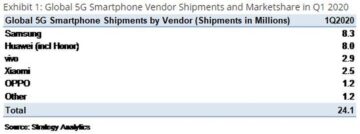
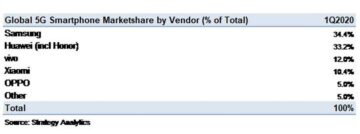
Demand for 5G smartphones increased significantly in Q1 2020 compared to last year, and Samsung is leading the pack in terms of 5G smartphone shipments, according to Strategy Analytics. Samsung had a 34.4% 5G market share in the first quarter of the year and shipped 8.3 million 5G smartphones.

A total of 24.1 million 5G smartphones have been shipped globally throughout Q1 2020. This figure shows significant demand for 5G phones, as it has already exceeded the total of 18.7 million 5G phones shipped across 2019.

Galaxy S20 5G and S20 Ultra 5G are Samsung’s more popular 5G phones

Samsung sits in the lead in terms of 5G smartphone shipments and it’s closely followed by Huawei with 8 million units shipped. Out of 24.1 million 5G phones shipped in the first quarter of the year, 8.3 million were Samsung’s. Popular 5G models include the Galaxy S20 5G and S20 Ultra 5G.

The major difference between the two OEMs is that Samsung’s 8.3 million 5G devices were shipped in various countries including the USA, South Korea, and some markets in Europe, whereas Huawei is enjoying high demand in China despite the COVID-19 pandemic. The 3rd largest 5G smartphone vendor was Vivo with 2.9 million shipments and 12% market share.

According to Strategy Analytics, demand for 5G smartphones in China should continue ‘to expand dramatically in 2020.’ Whether or not this will give Huawei an advantage over Samsung in the following quarters remains to be seen. Presently, China is leading in terms of demand for 5G devices, and markets including Europe, the USA, and South Korea may or may not be able to catch up and surpass it in the following quarters. Samsung remains one of the least popular smartphone brands in China regardless of whether they are LTE or 5G-enabled.

The post Samsung leads the 5G race in Q1 2020, Galaxy S20 5G is in demand appeared first on SamMobile.


from SamMobile https://ift.tt/2Se0LaC
via IFTTT

Samsung confirms its 2020 4K QLED TVs have HDMI 2.1

Samsung’s 4K QLED 2020 TV lineup is now available for purchase in various markets, but while the official spec sheet for these models is fairly detailed, the company failed to specify their exact HDMI capabilities. In other words, it’s unclear whether Samsung’s 4K QLED 2020 TV series has HDMI 2.1 capabilities. Or at least, it was unclear until recently when Samsung confirmed to FlatspanelHD that its 4K 2020 TV lineup does benefit from HDMI 2.1.

HDMI 2.1 on Samsung’s 2020 4K QLED TVs with a caveat

According to the online publication citing Samsung, all of the company’s 4K QLED 2020 TVs, including the Q60T, Q70T, Q80T, Q90T, and Q95T have HDMI 2.1 capabilities, but there’s a caveat. Although all these models have a total of four HDMI outputs (save for the Q60T), only one of these ports follows the 2.1 specifications.

The good news is that the included HDMI 2.1 port will allow customers to benefit from features such as 4K gaming at 120Hz (via Fixed Rate Link – FRL) when connecting upcoming consoles such as the Xbox Series X and PlayStation 5.

However, it’s also worth noting that the HDMI 2.1 port is not used at its full potential on all of these models. According to the source, 4K 120Hz via FRL is not available on the Q60T and the smaller 49-inch Q80T model.

Meanwhile, Samsung’s 8K QLED TV models including the Q800T, Q900TS, and Q950TS all support HDMI 2.1 and 4K 120Hz FRL.

The post Samsung confirms its 2020 4K QLED TVs have HDMI 2.1 appeared first on SamMobile.


from SamMobile https://ift.tt/3cPlb1w
via IFTTT

جميع الحقوق محفوظة لمدونة الغريب 2013