الأحد، 20 ديسمبر 2020

Samsung vs Huawei in 2020: Never been closer to losing the crown

Samsung remains the biggest smartphone maker in the world at the end of 2020, but the company has never come closer to losing its spot to another Android OEM than it did this year. That other OEM, Huawei, actually edged past Samsung in April due to a number of contributing factors, of which one was the US trade ban, interestingly enough.

This was a short-lived success though, as you’re most likely aware. Huawei remains one of the world’s biggest smartphone brands but that’s mostly thanks to its success in China. Outside of China, it’s a different story.

Samsung vs Huawei in 2020: The top dog gets a lucky break

Overt the past half a decade, Huawei became one of the most popular smartphone brands in the world. It offered a rich portfolio of products, from affordable phones and tablets to high-end models that were able to steal some of Samsung’s sales figures in several key markets.

At one point Huawei became a real threat to Samsung in key western markets. It came closer to taking the crown from Samsung than any other Android OEM, but ultimately Huawei lost a lot of ground because of the US trade sanctions and various restrictions. For smartphone owners, this means Huawei smartphones no longer offer support for Google services, so no matter how solid the hardware may be, the software experience is fundamentally lacking.

Huawei maintained good shipping figures globally in 2020 but mostly thanks to its home country China. In the USA, Huawei’s smartphone market share is negligible, while shipments in Europe have been in a nosedive throughout the first three quarters of the year, as highlighted in this graph by Statista.
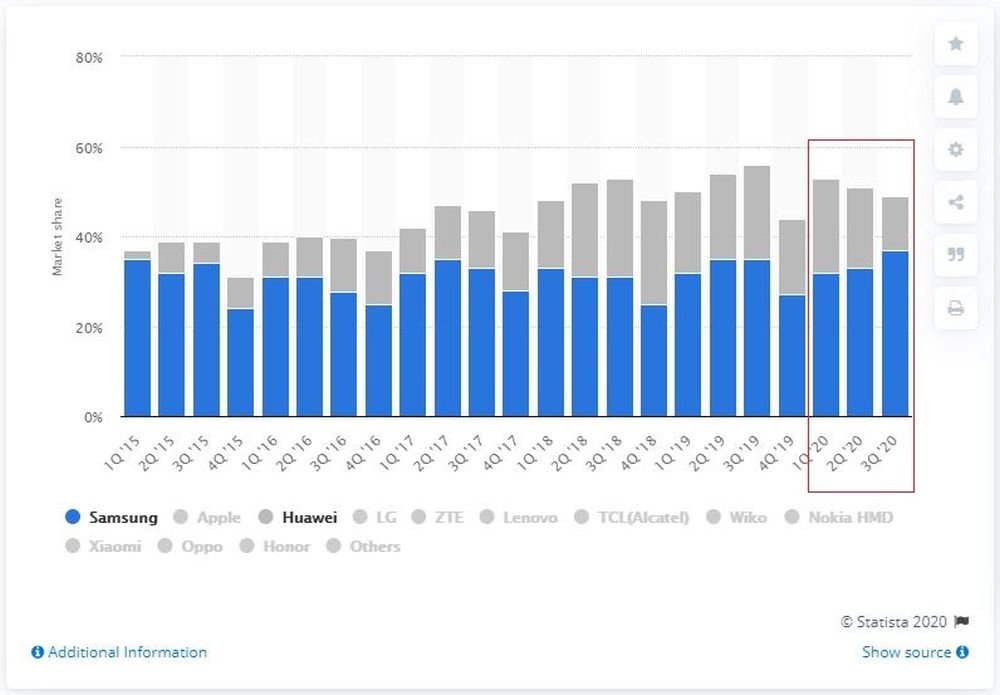
Huawei’s loss in Europe throughout the first three quarters of 2020 turned into success for Samsung. Russia was a similar story as Samsung regained the top spot from Huawei in Q3 2020.

But while Samsung Mobile’s marketing team was doing its part to pour salt in Huawei’s wounds, Samsung Display made sure it kept Huawei as a client. It sought and reportedly gained approval from the US Department of Commerce for the right to sell OLED panels to Huawei.

They both had a ridiculously rich product portfolio

Shipment figures and market share distribution aside, both Samsung and Huawei had a ridiculously rich mobile product portfolio in 2020. Samsung’s mid-range Galaxy A and M series thrived and the company is offering three Galaxy S20 models plus a dedicated Fan Edition Galaxy S20 FE, and two Galaxy Note 20 flagships.

Samsung remains the top Android tablet maker and this year it released the Galaxy Tab S6 Lite, the Galaxy Tab S7 and Galaxy Tab S7+, as well as the Galaxy Tab A 8.4 and the Galaxy Tab Active 3. Huawei has released a handful of tablet models of its own but none of them have a rugged shell or come with an input device similar to the S Pen. This is equally valid for Huawei’s smartphone portfolio.

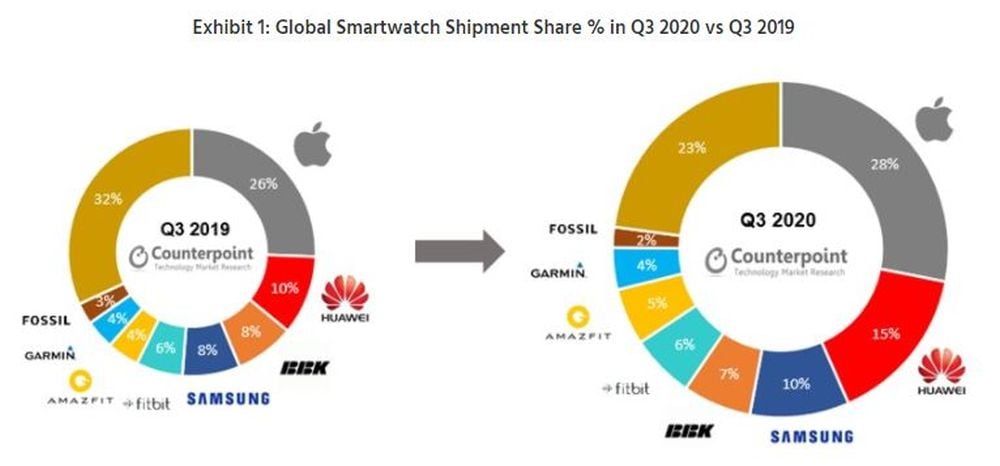
As for smartwatches, both Huawei and Samsung have experienced year-on-year growth in Q3 2020, with Samsung holding 10% of the market (up from 8%) and Huawei having the upper hand with 15% market share (up from 10%), according to Counterpoint Research. But Samsung achieved 10% market share with fewer wrist wearable models released in 2020. They were the Galaxy Watch 3 and Galaxy Fit 2. Comparatively, Huawei has released five smartwatch models including one that resembles the Apple Watch, and a kids watch.
All things considered, although Huawei’s influence in western markets is declining, the company seems to have maintained its course, which must count for something. Huawei’s chipset arm continues releasing new Kirin chipsets. The Kirin 990 SoC that’s powering devices like the Huawei P40 Pro seem to generally do a better job than the Exynos 990 in synthetic benchmarks such as Geekbench. 2020 was a relatively better year for Samsung but, in many ways, the company may have gotten lucky.

Samsung vs Huawei in 2020: Samsung won the foldable war

Samsung’s victory across the foldable market has so far been uncontested. The original Huawei Mate X didn’t stand a chance against the Galaxy Fold, and the refreshed Mate Xs model – which was released as early as March – didn’t fare any better against it either. The spotlight was much more focused on the Galaxy Z Flip and, as we’ve mentioned before, maybe a foldable display on the outside of a phone really isn’t such a great idea…
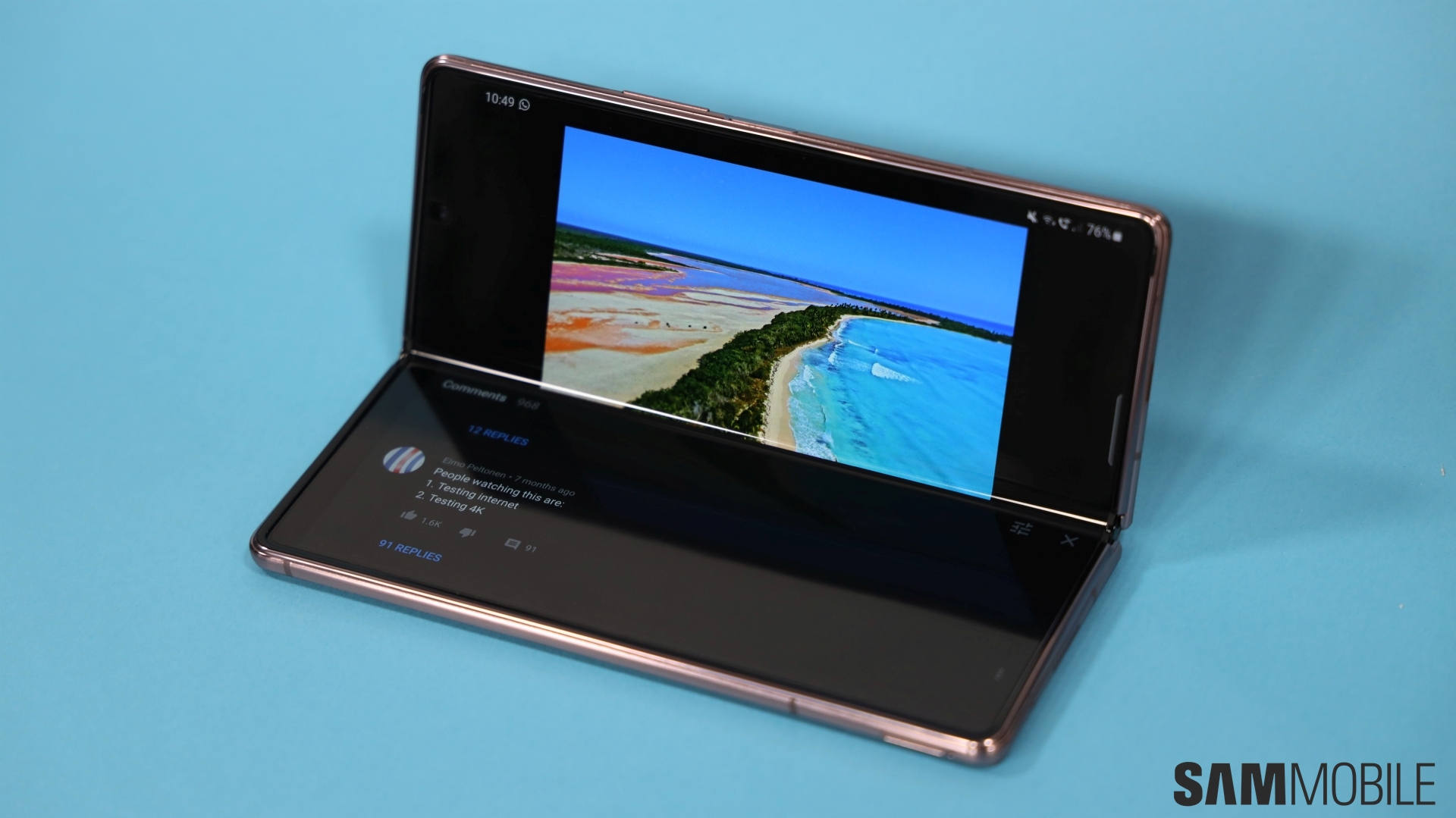
The Galaxy Z Fold 2 came along in September and it’s become the go-to flagship foldable for anyone who’s serious about this emerging technology and wants to experience the best. Right now, Samsung is the brand for foldable mobile tech and it may take years for a real competitor to show up. Huawei may have seemed like a threat in 2019, but this year it became obvious who the better innovator was in this segment.

Samsung vs Huawei in 2020: A decisive year for 5G

Regardless of how things went for Samsung and Huawei in the mobile space or the display/memory supply segments, Samsung’s biggest victory with long-term consequences was perhaps that in the 5G race. We’re referring to 5G network equipment and not 5G-enabled consumer products.

Last year the global 5G market seemed split between Samsung and Huawei, with the latter establishing footholds in the USA and Canada after the ban on Huawei. It seemed like the Chinese tech giant would be able to offset its losses with a strong 5G presence over the European continent but 2020 was decisive for the company.

Network operators in numerous European countries have decided to ban Huawei from selling 5G equipment; others have decided against renewing their ongoing contracts with Huawei once they expire in the coming years.

Huawei’s misfortune has allowed Samsung to step in and provide an alternative to Huawei’s 5G solutions in many of these countries. In other words, Huawei’s 5G market share has declined while Samsung continues to win new 5G contracts in more markets. 2020 has shaped the 5G segment in a way that will ripple across the industry over the coming years and Samsung will probably ride the wave.


2020 was a tough year for a lot of OEMs, logistics-wise if nothing else, but Huawei had to deal with the unexpected market changes as well as the restrictions imposed by the USA and other nations. But the company hasn’t imploded as some may have expected. Instead, it continues to enjoy success in China.

Samsung has greatly benefited from Huawei’s losses in many segments but the company was also able to innovate and adapt to market changes. Nevertheless, Samsung almost lost the lead in the smartphone race to Huawei in 2020 and if it hadn’t been for the bans and restrictions, who knows what the present would’ve looked like? Feel free to take a guess in the comment section below.

The post Samsung vs Huawei in 2020: Never been closer to losing the crown appeared first on SamMobile.


from SamMobile https://ift.tt/2LLXwH2
via IFTTT
Samsung Galaxy phones and tablets with high refresh rate displays

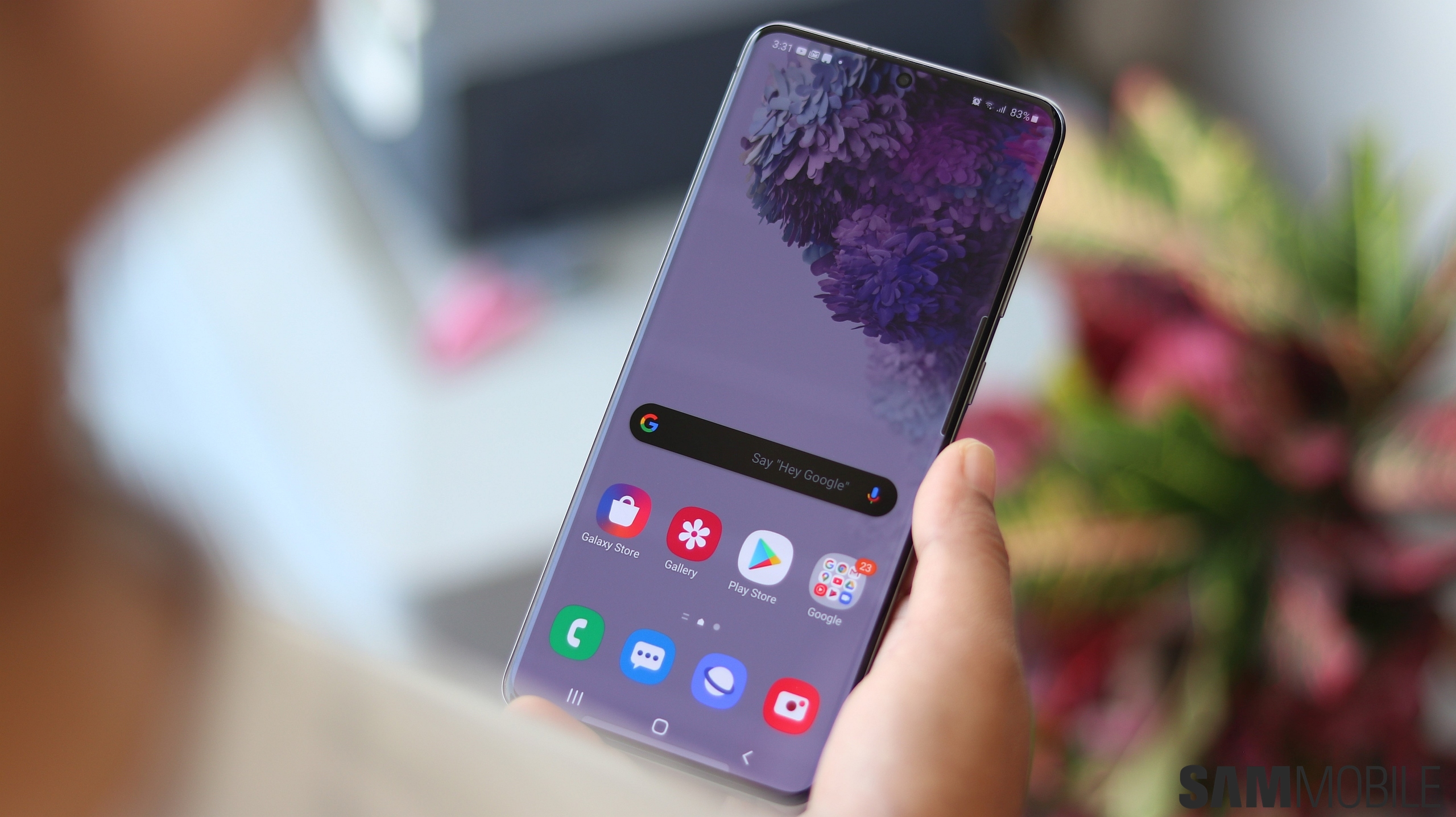
Smartphones with high refresh rate screens offer a relatively smoother and more fluidic experience while navigating around the UI, scrolling, swiping, zooming, and gaming. Samsung was late to the party when it comes to releasing devices with high refresh rate displays, but the company now has among the widest range of such phones and tablets. While most of the brands started off with 90Hz screens, Samsung jumped straight to 120Hz refresh rate screens.

Now that there are a lot of Galaxy devices (eight, as of December 20) that have high refresh rate screens, we thought it might be a good idea to create a list of all those devices. We will regularly update this list as and when Samsung releases new devices with high refresh rate displays.

Which Galaxy phones and tablets have high refresh rate displays?

  • Galaxy S20: This phone has a 6.2-inch Dynamic AMOLED 2x display with QHD+ resolution (3,200 x 1,440 pixels) and a 120Hz refresh rate. It also features HDR10+, Always-On Display, an ultrasonic in-display fingerprint reader, and Gorilla Glass 6 protection. Both the LTE and 5G versions of the phone have a 120Hz refresh rate screen.
  • Galaxy S20+: LTE and 5G variants of the Galaxy S20+ sport a 6.7-inch Dynamic AMOLED 2x display with QHD+ resolution (3,200 x 1,440 pixels) and a high refresh rate of 120Hz. It can playback HDR10+ content and features Gorilla Glass 6 protection over the screen. Features like AoD and an ultrasonic in-display fingerprint reader are also present.
  • Galaxy S20 Ultra: The Galaxy S20 Ultra has a 6.9-inch Dynamic AMOLED 2x display with a 120Hz refresh rate, a peak brightness of 1,400 nits, QHD+ resolution, and HDR10+ certification. Similar to other Galaxy S20 series phones, it features an ultrasonic in-display fingerprint reader, AoD mode, and Gorilla Glass 6 protection.
  • Galaxy S20 FE: This phone is the cheapest Galaxy S20 device, and it comes with a 6.5-inch Super AMOLED display with Full HD+ resolution, and a 120Hz refresh rate. It uses an optical in-display fingerprint reader, AoD mode, HDR10+, and its screen is protected by Gorilla Glass 3.
  • Galaxy Note 20 Ultra: The Galaxy Note 20 Ultra has a 6.9-inch Dynamic AMOLED 2x display with a 120Hz adaptive refresh rate and QHD+ resolution. Its display is protected by Gorilla Glass Victus. It features an ultrasonic in-display fingerprint reader, HDR10+ certification, and AoD mode.
  • Galaxy Z Fold 2: Samsung’s second-generation Fold device has two screens, a 6.23-inch Super AMOLED display on the outside and a 7.6-inch Dynamic AMOLED 2x foldable display on the inside. The inner display can be folded and it has a 120Hz adaptive refresh rate, QXGA+ resolution (2,208 x 1,768 pixels), HDR10+ certification, and Ultra Thin Glass (UTG) protection. The outer display has a 2,260 x 816 pixels resolution and a 60Hz refresh rate.
  • Galaxy Tab S7: The Galaxy Tab S7 uses an 11-inch LTPS IPS LCD screen with a 120Hz refresh rate, QHD+ resolution, HDR10+ playback certification, and 500 nits of peak brightness. It comes with an S Pen and a latency of just 26ms.
  • Galaxy Tab S7+: The Galaxy Tab S7+ sports a 12.4-inch Super AMOLED display with a 120Hz refresh rate and QHD+ resolution. It comes bundled with an S Pen, which has a latency of just 9ms.

Samsung is also launching three more smartphones with high refresh rate screens next month: Galaxy S21, Galaxy S21+, and Galaxy S21 Ultra. Only the Galaxy S21 Ultra is said to feature a QHD+ Dynamic AMOLED 2x screen with adaptive 120Hz refresh rate. The other two Galaxy S21 series smartphones will reportedly feature Full HD+ Dynamic AMOLED 2x screens with a non-adaptive 120Hz refresh rate.

The post Samsung Galaxy phones and tablets with high refresh rate displays appeared first on SamMobile.


from SamMobile https://ift.tt/3mAg0XY
via IFTTT

السبت، 19 ديسمبر 2020

Samsung vs OnePlus in 2020: One UI clones and stolen Buds

It’s the final stretch of the year and in many ways, we’re all happy to leave 2020 behind. For Samsung and its customer base, 2020 was a good-enough year given the circumstances. Firmware updates have arrived on time for the most part and plenty of exciting devices have come out of Samsung’s factory gates throughout the year.

But instead of looking back at the company’s achievements in a vacuum, perhaps it would be more interesting to compare Samsung’s performance in 2020 with that of its key rivals. After all, Samsung doesn’t exist in a bubble, but rather it competes with a wide variety of OEMs. OnePlus, the brand that coined the term flagship killer, being one of them.

Samsung vs OnePlus in 2020: Someone is a fan…

Samsung is a giant compared to OnePlus so it would be unfair to compare their influence across the industry. The former has developed exciting new technologies and has released two foldable smartphones, the Galaxy Z Fold 2 and the Galaxy Z Flip, whereas the latter has more or less maintained its course.

More important than how each OEM has influenced the industry is how they’ve influenced each other. And in this respect, Samsung was clearly the inspiration. OnePlus seems to have borrowed a lot from Samsung, especially with its latest custom Android skin which, to put it very lightly, draws inspiration from One UI.

Not every UI element is the same or in the same location across Oxygen OS and One UI, but anyone who doesn’t possess a trained eye will be forgiven for not telling the difference between the two.

OnePlus also took a page from Samsung’s book when it came to the wearable market. OnePlus doesn’t produce smartwatches but the company did release a couple of new totally-wireless earbuds this year. And, in case you haven’t heard, you’ll be surprised to learn that they’re called the OnePlus Buds and OnePlus Buds Z. But don’t worry; although they’re called the same as Samsung’s Galaxy Buds series, they look nothing alike and aren’t a direct competitor.

The OnePlus Buds cost $79. The Buds Z are a $49 alternative. They’re cheaper than the Galaxy Buds+ and the Galaxy Buds Live, obviously, and that’s because they lack in features, from the number of on-board microphones to their battery sizes, lack of wireless charging, ANC and more. And again, the OnePlus Buds? Really?! A jury would dock a point just for that.

The bottom line is, Samsung left a noticeable mark on OnePlus in 2020, which might be a hint as to the direction OnePlus might be going next.

Samsung vs OnePlus in 2020: Adapting to market changes

Samsung has more high-end phones on offer than ever before, which seems counter-productive given the economic climate. OnePlus has so far released three OnePlus 8 models – one less than last year. OnePlus did things a little differently and released three brand-new mid-range phones labeled Nord. OnePlus evangelists consider the Nord series to represent the flagship killer’s return and a threat to Samsung.

In reality, it might already be too late for any flagship killers to challenge Samsung’s diverse smartphone portfolio. But regardless, OnePlus was able to adapt to the market changes in 2020 and create a new smartphone series as a response.

In the opposite camp, the Galaxy A and Galaxy M series were very successful in 2020 thanks to a combination of great value and specs, whereas the Galaxy S20 FE can be viewed as a direct response to the whole flagship killer concept. The company has also released the Galaxy Note 10 Lite as its first S Pen smartphone that wasn’t a flagship.

But although there’s a lot more variety in Samsung’s smartphone portfolio, perhaps the company may have gone a little too far with its budget offers this year. The Galaxy F41 and the Galaxy M31 Prime stand out as desperate attempts at reselling existing phones under a different brand. And did anyone really need a re-release of the Galaxy J2 Core in 2020? These releases were some of Samsung’s low points of 2020, but then again, this year the company has also released some of the most impressive mobile products of the decade.

Samsung vs OnePlus in 2020: An unexpected role reversal

OnePlus seems to be losing its way while Samsung has set an example in terms of firmware support this year. It’s almost as if the roles have reversed. OnePlus used to be the Android OEM to beat, but this year the company has unexpectedly decided to launch its new Nord series with a frankly embarrassing guarantee of a single Android OS update.

galaxy s20 software update

Samsung is now promising three major Android OS updates for the majority of Galaxy smartphones that got released with Android 9 or later, whereas OnePlus guarantees only a single Android OS update for the brand-new OnePlus Nord N10 and Nord N100. You could say that Samsung is beating OnePlus at its own game.

One Plus is offering better, faster firmware support for its flagship series compared to Nord but, surprise! So is Samsung, who’s now rolling out One UI 3.0 even earlier than expected. The experience itself has gotten better, with new features and a refined UI contributing to the package.


Samsung did a stellar job against OnePlus’ Nord offensive and flagship killer concept this year, we believe, especially given the market conditions. But what do you think of the competition between the two? And, be honest, have you ever considered switching from Samsung to OnePlus this year? Feel free to join the conversation below.

The post Samsung vs OnePlus in 2020: One UI clones and stolen Buds appeared first on SamMobile.


from SamMobile https://ift.tt/38mApub
via IFTTT

الجمعة، 18 ديسمبر 2020

Looking for the Galaxy S21 Ultra spec sheet? It just leaked in full

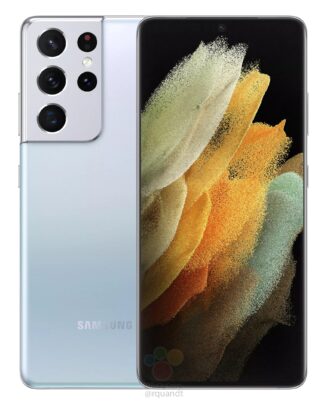
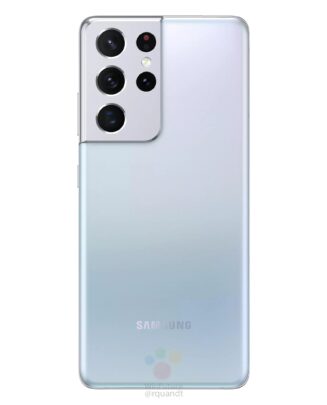
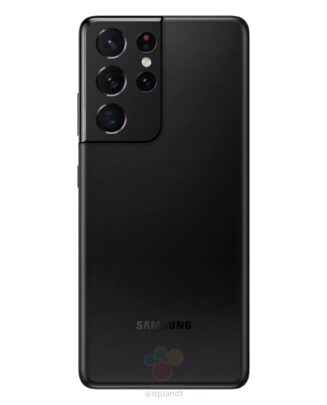
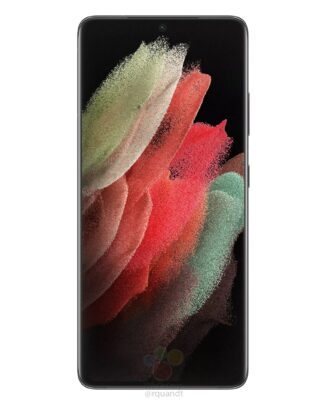
The Galaxy S21 line might as well be getting announced today. Because what we’re bringing to you now is an info dump from Germany that’s as full-featured as an official Samsung press release. It even comes complete with high-resolution images of the Galaxy S21 Ultra in Phantom Black and Phantom Silver.

Procured by known industry insider Roland Quandt of WinFuture, this huge leak pretty much confirms full specs of the Galaxy S21 Ultra, in addition to shedding more light on the rest of Samsung’s incoming flagship lineup. Quite a development seeing how it’s barely been a few hours since we’ve seen a legitimate five-minute review of the Galaxy S21+, right?

Will the Galaxy S21 Ultra make up for the camera shortcomings of its predecessor?

Let’s start with the basics, as this particular leak describes the international variant of the Galaxy S21 Ultra. This would be the one powered by the Exynos 2100, Samsung’s most promising chipset in over half a decade. The said silicon is an octa-core affair with four 2.4GHz high-efficiency cores, a triple-core, 2.8GHz cluster focused on performance, and one final 2.9GHz champ that’s here to flex on benchmarks all day long.

A 6.8-inch Dynamic AMOLED 2X panel, still advertised as the Infinity-O-Edge, constitutes the face of the Galaxy S21 Ultra. And it ups the smoothness bar of Samsung’s previous flagships by supporting 120Hz imagery all the way up to WQHD+, or 2K (3,200 x 1,440) resolutions. One UI 3.1 based on Android 11 is also here, as is a 12GB RAM configuration and a choice between 128GB, 256GB, and 512GB of storage. There is no microSD card slot to speak of, unfortunately, which adds weight to the decision on which specification to go for.

The front camera of the device is a 40-megapixel unit with a 25mm lens sitting in front of it, which is almost as wide-angle as you can go without ending up in the fisheye territory.

Meanwhile, the rear panel of the Galaxy S21 Ultra houses a quad-camera setup that Samsung hopes will make up for all of its predecessor’s shortcomings. The heart of the system is a 108-megapixel sensor mounted behind a 24mm wide-angle lens with an extremely fast f/1.8 aperture. This unit supports optical image stabilization and has the same 1/1.33-inch sensor footprint the Galaxy S20 Ultra did, 0.8μm pixel size included. Combining with it is a 12-megapixel ultra-wide-angle (13mm, so fisheye) camera, a 10-megapixel telephoto (72mm) lens, and… another 10-megapixel telephoto, but of the superzoom, 240mm variety. Both of the long-distance shooters feature OIS and a pixel size of 1.2μm, so they might actually be usable in way more than just perfectly lit scenarios.

That large variety of focal distances also promises a highly capable hybrid zoom offering 3-10x magnifications. Phase detection autofocus, laser autofocusing, and a dual-LED, dual-tone flash are all on board, as well.

Despite that monstrosity on its back, the Galaxy S21 Ultra will actually be smaller than its direct predecessor, if only 0.1mm thicker. Its final dimensions are said to be 165.1 x 75.6 x 8.9mm. The Exynos variant of the device supposedly tips the scales at 228g, 6 grams more than the Galaxy S20 Ultra. And all of that cutting edge hardware draws power from a 5,000mAh battery with 45W charging support, which is also compatible with the widely adopted Qi wireless charging standard.

The post Looking for the Galaxy S21 Ultra spec sheet? It just leaked in full appeared first on SamMobile.


from SamMobile https://ift.tt/34ojhmX
via IFTTT

BREAKING: Samsung’s new flagship Exynos chip goes official January 12!

Samsung has revealed that its new flagship Exynos chip will be made official on January 12, two days before the Galaxy S21 series is expected to be unveiled. And judging by the teaser posted by the Samsung Exynos account on Twitter, which ends with the words Exynos is back, it looks like the Exynos 2100 will really be a return to form for the Korean giant’s chipset division, and that’s a big reason to be excited after the missteps in the last couple of years.

Based on what we know so far, that return to form will simply be a result of Samsung giving up its lofty ambitions of having a custom processor core for its in-house SoC. The Exynos 2100 will use standard ARM cores – there will be a single super-high performance core, three performance cores, and four power-efficient cores, along with the Mali-G78 GPU rounding up the package. While a leak from earlier today suggests Samsung could use the old 7nm manufacturing process for the Exynos 2100, it’s most likely that the company will employ its new 5nm process instead, the same one that is used for the Exynos 1080 and the Qualcomm Snapdragon 888.

Speaking of the Snapdragon 888, it will be interesting to see how the Exynos 2100 fares in comparison. The subpar Exynos 990 that powers the Galaxy S20 lineup has left a bitter aftertaste for Samsung fans, and this may be the company’s final chance to turn the ship around. Thankfully, whether or not it’s able to do that is a question that won’t remain unanswered for long, as we’re less than a month away from the Galaxy S21 lineup’s official launch.

The post BREAKING: Samsung’s new flagship Exynos chip goes official January 12! appeared first on SamMobile.


from SamMobile https://ift.tt/3p1XoBE
via IFTTT

Sprint, T-Mobile now pushing One UI 3.0 update to Galaxy Note 20 owners

Remember Sprint? Well, neither does Marcelo Claure, but the somewhat freshly acquired T-Mobile unit has lately been staying on top of Samsung’s Android updates like there’s no tomorrow. Or, like it has new bosses to impress, to be more specific. Case in point: the fact that its Galaxy Note 20 (SM-N981U) and Galaxy Note 20 Ultra (SM-N986U) models just started receiving their One UI 3.0 update based on Google’s Android 11. The same one that’s currently picking up momentum all over the world.

Much like both 5G-ready flagships on T-Mobile’s own network, as a matter of fact. The development comes hot on the heels of the very first Android 11 update for the Snapdragon-equipped members of the Galaxy Note 20 series – those locked to AT&T’s network. As T-Mobile’s closest rival started rolling out the new firmware to its customers across the United States less than a week ago.

Is your download already standing at the ready?

Identified by build versions N981USQU1CTL2  and N986USQU1CTL2, this pair of generational software upgrades for the Galaxy Note 20 and Galaxy Note 20 Ultra started rolling out to eligible devices across the country within the last 24 hours. These rollouts tend to be gradual as carriers want to mitigate the risk of network congestion, but that doesn’t mean there aren’t ways for you to cut the waiting line.

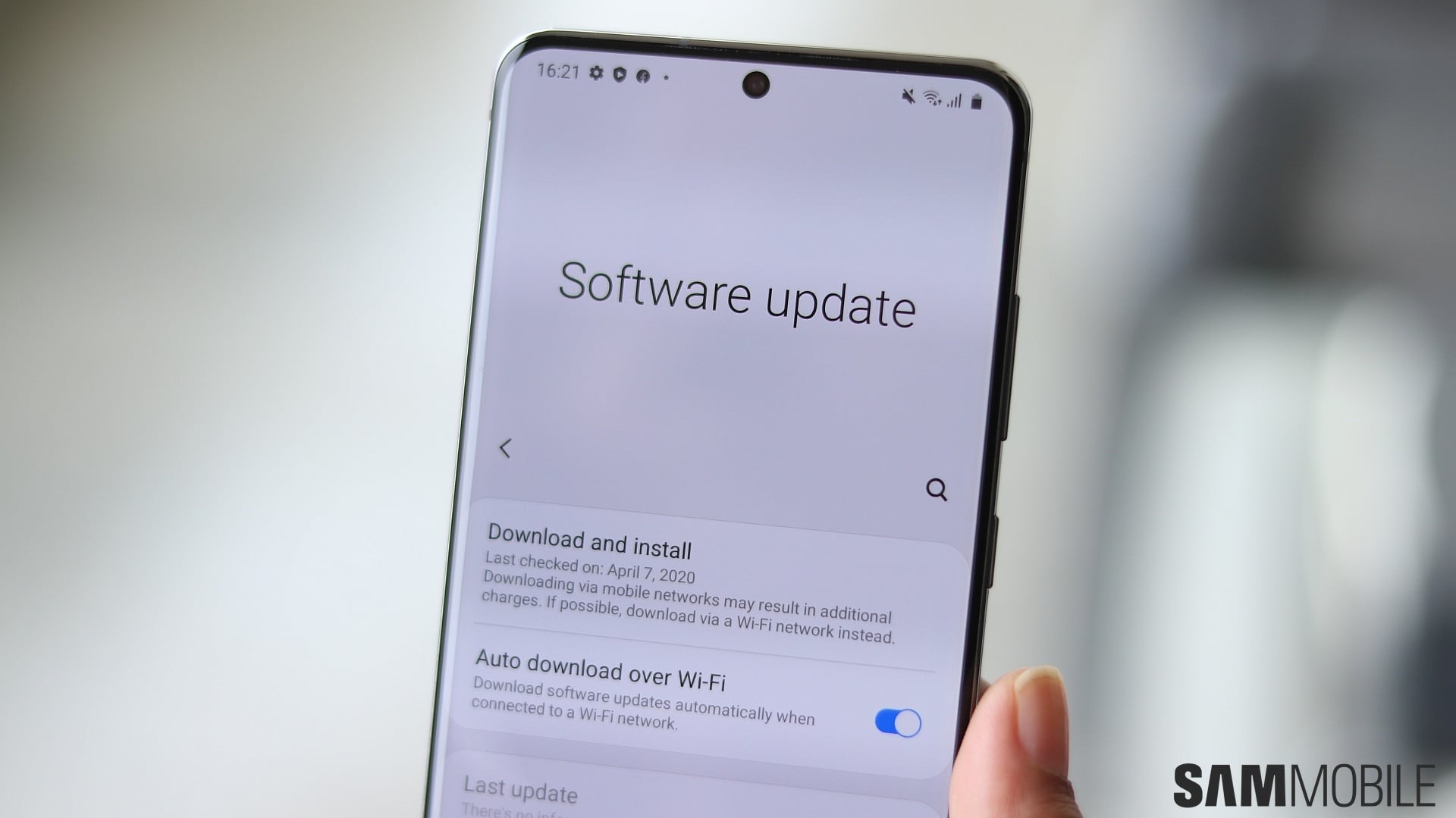
Namely, you might get lucky by manually searching for an over-the-air download. You can try doing so by opening Settings, going to the Software update menu near the bottom, and tapping the top option that says Download and install on the following screen.

Alternatively, our trusty firmware archives already have full system images for every single one of the aforementioned models. But manually flashing those onto compatible Galaxy Note 20 units should only be left to the experienced tinkerers (who always remember to make device backups).

  • Model: SM-N981U
  • Dimensions: Bar: 161.6 x 75.2 x 8.3 mm
  • Display: 6.7 inch / 170.18 mm Super AMOLED Plus
  • CPU: Snapdragon 865+
  • Camera: 12MP
  • Model: SM-N986U
  • Dimensions: Bar: 164.8 x 77.2 x 8.1 mm
  • Display: 6.9 inch / 175.26 mm Dynamic AMOLED 2X
  • CPU: Snapdragon 865+
  • Camera: 108MP

The post Sprint, T-Mobile now pushing One UI 3.0 update to Galaxy Note 20 owners appeared first on SamMobile.


from SamMobile https://ift.tt/37uJvWI
via IFTTT

Way better, right? Galaxy A72 5G leaks in a much livelier color

The Galaxy A72 5G leaked for the second day in a row, once again courtesy of industry insider Steve Hemmerstoffer, better known by his handle OnLeaks. And this time around, Samsung’s upcoming Android mid-ranger is presenting itself in a much more exciting, livelier color. Plus, this latest sighting even happens to move, coming in the form of a 360-degree video that you can view below.

As for the particular hue being used, this color appears to be reminiscent of the Prism Blue finish offered as an option with the preceding Galaxy A71. Though these unofficial renders based on alleged factory device specifications are somewhat more saturated and hence closer to the sapphire shade of blue.

Could the Exynos 1080 actually end up on board of this thing?

The bad news is that this newly emerged video depiction of the Galaxy A72 5G serves as the final nail in the coffin for the rumor about a five-camera setup possibly being part of this package. Not that there’s been much hope on that front since last week.

Despite some industry-wide speculation about the Exynos 1080 being the brains of the Galaxy A72 5G, that possibility is still deep inside the wishful thinking territory. That isn’t to say we aren’t keeping our fingers crossed, but it would probably be wise not to expect too much. By all accounts, Samsung does not intend to bring the Exynos 1080 outside of China just yet. Regardless, the Galaxy A72 5G is expected to launch alongside an LTE-only Galaxy A72, with the latter supposedly carrying the international designation of SM-A725F.

The post Way better, right? Galaxy A72 5G leaks in a much livelier color appeared first on SamMobile.


from SamMobile https://ift.tt/38cujNe
via IFTTT

جميع الحقوق محفوظة لمدونة الغريب 2013