الخميس، 1 أبريل 2021

Galaxy A Quantum 2 specs revealed via Google Play Console

Samsung is working on a premium mid-range smartphone, the Galaxy A82 5G. It is the successor to the Galaxy A80 and it could be rebadged as the Galaxy A Quantum 2 in South Korea. The smartphone first appeared two months ago and some of its specifications were revealed over the past few weeks. Now, the phone’s front design, internal hardware, and software version have surfaced, telling us more about the phone.

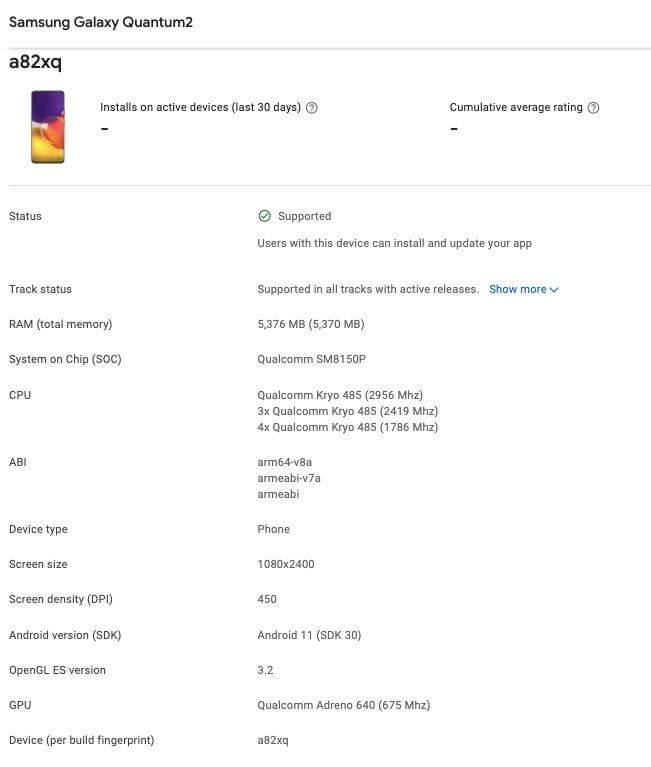
The Galaxy A Quantum 2 (SM-A826S) was found in Google Play Console listings. The phone appears to feature a full-screen design at the front. Going by the specifications available in Google Play Console, the phone features a Full HD+ screen and runs Android 11. The Galaxy A Quantum 2 is equipped with the Snapdragon 855+ processor (SM8150P) and 6GB of RAM. While the Galaxy A80 featured a flip selfie camera system, the Galaxy A Quantum appears to have a traditional punch-hole-shaped selfie camera.

It has been reported in the past that this upcoming smartphone features a 64MP (Sony IMX686) rear-facing camera and Bluetooth 5.0. Nothing else is known about this smartphone, but we expect it to feature a QRNG (Quantum Random Number Generator) chip for enhanced security compared to traditional smartphones. This smartphone could be exclusive to South Korea. For other markets, it could be released as the Galaxy A82 5G and without the QRNG chip.

The original Galaxy A Quantum (based on Galaxy A72) featured a 6.7-inch Super AMOLED Infinity-O display, an Exynos 980 processor, a 64MP quad-camera setup, a 32MP selfie camera, and a 4,500mAh battery with 25W fast charging.

Samsung Galaxy A Quantum 2 Specs

Samsung Galaxy A Quantum 2 SM-A826S Google Play Console Listing

The post Galaxy A Quantum 2 specs revealed via Google Play Console appeared first on SamMobile.


from SamMobile https://ift.tt/3durBW2
via IFTTT

الأربعاء، 31 مارس 2021

Galaxy Z Fold 2 vs Xiaomi Mi Mix Fold: Have the clone wars begun?

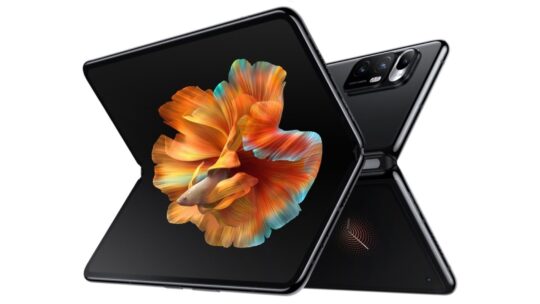
A new foldable phone has been officially announced in China — not by Samsung but by one of its rivals — and it looks as if it was heavily inspired by the Galaxy Z Fold 2. It’s called the Xiaomi Mi Mix Fold, and much like the Huawei Mate X2, it follows the design standard that was established by Samsung’s foldable series roughly two years ago.

The Xiaomi Mi Mix Fold has a book-like design with a foldable panel on the inside and a rigid cover display on the outside. This is the same formula that was employed by both the Galaxy Fold and the Galaxy Z Fold 2 to great success. The Xiaomi Mi Mix Fold attempts to create its own identity around the foundation that was laid down by Samsung but it ends up borrowing the Fold moniker.

The big question now is whether or not the Xiaomi Mi Mix Fold can compete with the Galaxy Z Fold 2, at least as far as specifications are concerned. Availability-wise, Samsung remains the best foldable OEM because customers outside of China won’t be able to buy the Xiaomi Mi Mix Fold through official channels. But barring availability, is the Galaxy Z Fold 2 under threat? Let’s have a closer look.

Galaxy Z Fold 2 vs Mi Mix Fold: What has Xiaomi done differently?

Displays

Beyond the striking resemblance between the two foldable phones, the Galaxy Z Fold 2 and the Xiaomi Mi Mix Fold don’t have a lot in common. Xiaomi’s solution employs a cover display with an even narrower 27:9 aspect ratio, which might be too unwieldly for real practical uses. We feel like the Galaxy Z Fold 2’s cover display already is too narrow to provide a true smartphone experience, so the Xiaomi Mi Mix Fold took a step backwards in this regard.
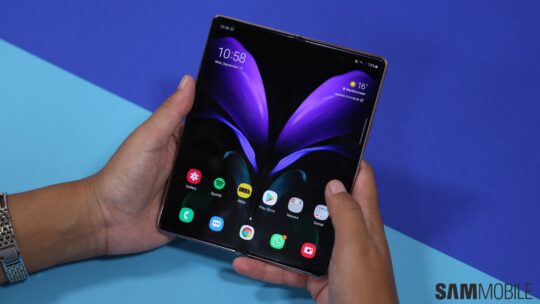
Galaxy Z Fold 2 review

The Chinese OEM also took a different approach to high refresh rate panels. While Samsung’s Galaxy Z Fold 2 has a 60Hz cover display and a 120Hz foldable Dynamic AMOLED 2X panel, Xiaomi has done the opposite and fitted the Mi Mix Fold with a 90Hz cover display and a 60Hz foldable AMOLED.

Internal specs

As you would expect, Xiaomi took advantage of the fact that the Mi Mix Fold was unveiled more than six months after the Galaxy Z Fold 2. Newer components have been developed since, and as a result, the Xiaomi foldable comes with a few upgraded components including the Snapdragon 888 chipset and more memory options.

Samsung’s rival is equipped with a double-cell battery that has a combined capacity of 5,020mAh. It can be recharged roughly two and a half times faster thanks to its 67W super fast charging capabilities.

Cameras

Xiaomi’s triple camera setup consists of a 108MP main sensor (vs. 12MP), an 8MP telephoto/macro shooter with a liquid lens and 3x optical zoom (vs. 12MP with OIS and 2x optical zoom), and a 13MP ultra-wide (vs. 12MP ultra-wide). It’s capable of 8K video recording, whereas the Galaxy Z Fold 2 isn’t.
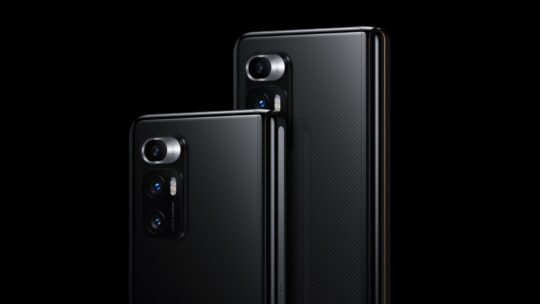
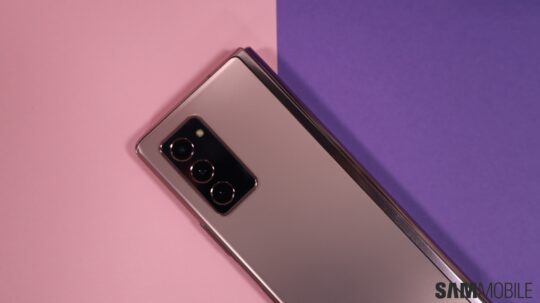
The cameras on the back of the Galaxy Z Fold 2 are getting left behind, and that’s especially true considering the fact that Samsung’s foldable has a 2x zoom camera from 2017. Needless to say, Xiaomi’s solution further highlights the fact that the Z Fold series is in need of a camera upgrade.

Other interesting tidbits

Like the Galaxy Z Fold 2, the Xiaomi Mi Mix Fold claims to redefine mobile multitasking and productivity. Oddly enough, it runs an older version of Android (10) and MIUI 12, whereas Samsung’s solution got updated to Android 11.

One UI’s multitasking capabilities on the Galaxy Z Fold 2 are limited to a maximum of three apps in split screen, whereas Xiaomi’s MIUI 12 takes a different approach by employing a desktop / tablet like UI. It looks like it might be a better fit for mobile productivity, at least judging by the marketing material.
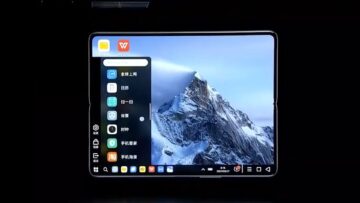
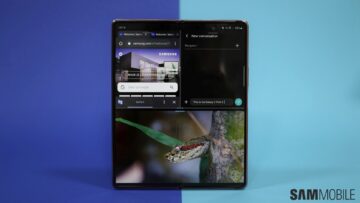
On the other hand, Xiaomi’s foldable doesn’t seem to have a DeX-like environment that would allow it to connect to a bigger screen, so the Galaxy Z Fold 2 is a better choice if you’re looking to bring the mobile experience to a TV or a computer monitor.

There are a couple of other things that the Xiaomi Mi Mix Fold does differently. It doesn’t have a display notch or cutout for the foldable panel, and it has quad speakers instead of two, which might make for a better multimedia experience.

Can Samsung learn something from the Xiaomi Mi Mix Fold?

Samsung is expected to upgrade a few key features with the release of the Galaxy Z Fold 3 later this year. It should boast an improved camera system, better internal hardware, and it might even support the S Pen. It will likely become the best foldable of the year, especially if the Mi Mix Fold represents the best Xiaomi has to offer.

Even so, Samsung could learn something from the Mi Mix Fold even if Xiaomi’s foldable phone has no chance of becoming a global phenomenon. One very attractive thing about the Mi Mix Fold is that it will go for sale in China for the rough equivalent of $1,500, making it $500 cheaper at launch than Samsung’s solution.

The upcoming Galaxy Z Fold 3 would also benefit from a quad-speaker setup, and perhaps MIUI 12 will inspire Samsung to create a more comprehensive UI for mobile productivity and multitasking. The foldable panel looks better without a cutout, so here’s hoping that in-display cameras will become a reality later this year.

At the end of the day, the Galaxy Z Fold 2 remains the most complete foldable phone to date, but it’s becoming obvious that Samsung should not ignore its emerging rivals. It looks like the foldable clone wars have begun and Samsung has to make sure that it remains one step ahead of its competition.

The post Galaxy Z Fold 2 vs Xiaomi Mi Mix Fold: Have the clone wars begun? appeared first on SamMobile.


from SamMobile https://ift.tt/2PfXRnK
via IFTTT

The Galaxy A51 gets another discount as US customers wait for its sequel

The Galaxy A52 might be the most exciting mid-range phone of the year but it is not yet available for purchase everywhere. It’s missing from store shelves in the USA, but the next-best thing — the Galaxy A51 — is now available at a discount of 13%.

Amazon is selling the factory unlocked Galaxy A51 with 128GB of storage in the USA for $349, down $50 from the usual $399 price. The offer is only available for the Galaxy A51 in black and it doesn’t apply to the 5G model.

The 4G-enabled Galaxy A51 is equipped with an Exynos 9611 chipset and a 4,000mAh battery with 15W charging. It has a 6.5-inch Super AMOLED display with a 60Hz refresh rate, and quad-camera setup coupled with a 32MP selfie sensor capable of 4K video recording. The phone shipped with Android 10 but it is now being updated to Android 11-based One UI 3.1 in some regions.

The Galaxy A51 was Samsung’s most successful smartphone of 2020. If you’re reading this, there’s a high probability that you already own a Galaxy A51, but if you don’t and would like to change that, this might be a good opportunity to do so. Especially if you can no longer afford waiting for the Galaxy A52 to hit the shelves in the USA.

Galaxy A51 review

The post The Galaxy A51 gets another discount as US customers wait for its sequel appeared first on SamMobile.


from SamMobile https://ift.tt/3djuI2Y
via IFTTT

The Galaxy Tab S7 series reaches a new low price with the latest discounts

Samsung continues leading the Android tablet market by a huge margin. If you’re in the market for a high-end solution, there’s no better option than the Galaxy Tab S7 or the Galaxy Tab S7+, so it’s a good thing that both tablets are now available at their lowest price yet.

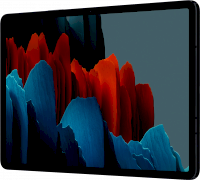
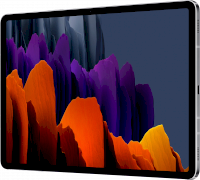
Amazon is now selling the Galaxy Tab S7 and the Galaxy Tab S7+ at a discount of up to 25% depending on variant. The Wi-Fi-only Galaxy Tab S7 with 128GB / 256GB / 512GB of storage is now available for as low as $512, $602, and $629, respectively, as long as you pick the Mystic Black color option. Other color variants — including the new Mystic Navy — are discounted as well, but Mystic Black gets the lowest price.

As for the Wi-Fi-only Galaxy Tab S7+, it, too is available at its lowest price yet as long as it’s painted in Mystic Black. The 128GB, 256GB, and 512GB models are now available for $681 (20% off), $702 (24% off), and $811 ($21% off), respectively.

The Galaxy Tab S7 series remains the best Android solution to date, though customers who are looking for lower-cost solutions should be getting a Galaxy Tab S7 Lite / Galaxy Tab S7+ Lite variant sooner rather than later. But if you’re more interested in the ongoing product lineup, you can refer to the links below for more details on the latest deals while they last.

Galaxy Tab S7+ review

  • Model: SM-T870
  • Dimensions: Tablet: 253.8 x 165.3 x 6.3 mm
  • Display: 11 inch / 279.4 mm LTPS TFT
  • CPU: Snapdragon 865+
  • Camera: 5MP

  • Model: SM-T970
  • Dimensions: Tablet: 285 x 185 x 5.7 mm
  • Display: 12.4 inch / 314.96 mm Super AMOLED Display
  • CPU: Snapdragon 865+
  • Camera: 5MP

The post The Galaxy Tab S7 series reaches a new low price with the latest discounts appeared first on SamMobile.


from SamMobile https://ift.tt/3cDqK5V
via IFTTT

Samsung SDI was the third-largest smartphone battery maker in 2020

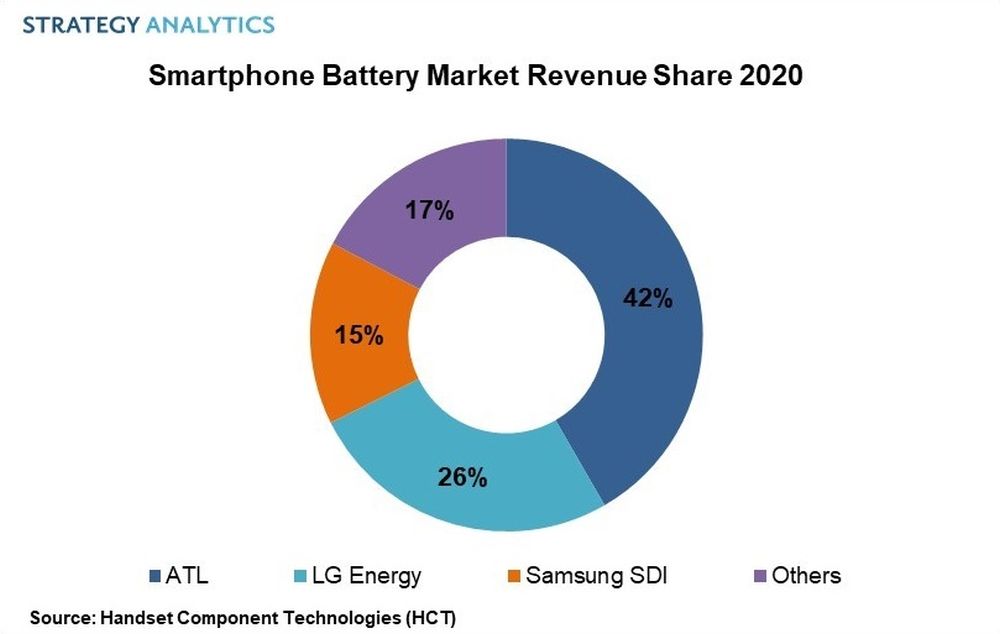
Samsung SDI was among the top 3 smartphone battery manufacturers in 2020. Global revenue from all manufacturers combined reached a total of $7.5 billion last year, and Samsung was able to capture 15% of the market.

The segment was led by Amperex Technology (ATL) with a market share of 42%. LG Chem was the second-largest smartphone battery manufacturer with a 26% share, and the remaining 17% market share was covered by other, smaller manufacturers.

According to a recent Strategy Analytics report, the smartphone battery cell market was driven by seasonal smartphone launches in the second half of the year, especially as smartphone manufacturers began adopting high-density and dual-cell batteries at a higher rate. This, however, appears to have benefitted ATL the most.

The 5G era is expected to boost the smartphone battery market

2021 is considered the year of 5G, as more smartphone manufacturers — including Samsung — will continue offering an increasingly-wide range of 5G-capable handsets at different price points.

And since 5G puts a greater strain on smartphone batteries, market watchers expect demand for high-density cells to rise even further throughout 2021.

Samsung SDI’s ambitions go beyond the smartphone market though. The company is now eyeing the EV (electric vehicle) market and it reportedly wants to build new EV battery production lines in Hungary by making a ~$1 billion investment.

The post Samsung SDI was the third-largest smartphone battery maker in 2020 appeared first on SamMobile.


from SamMobile https://ift.tt/3ughoTT
via IFTTT

First Samsung Quantum Dot TV prototype coming this spring

The first-ever Quantum Dot TV prototype from Samsung Display will be delivered to Samsung Electronics in late spring, according to a new report from the Far East. Dubbed QD-OLED, the technology has yet to be implemented into a consumer-level device. That state of affairs does not necessarily stem from any technical limitations, either.

Instead, Samsung Electronics and Samsung Display have reportedly been at odds regarding the future of television sets for some time now. And it wasn’t until recently that the former was willing to even entertain the idea of committing to QD-OLED panels. The other alternative would be to pursue the so-called QNED solutions, short for “quantum nano-emitting diodes/nanorods”.

Quantum-what now?

Assuming a lesson in supramolecular chemistry is not what you’re here for, what you need to know is that Samsung Electronics is scheduled to receive the final QD-OLED prototype for technical testing and market evaluation this June, as South Korean sources now claim.

Despite the logistical nightmare that 2020 turned out to be, the timeline for the potential release of Samsung’s first QD-OLED TVs perfectly matches the initial industry watcher projections from last year. This does not mean we’ll necessarily see consumer-grade QD-OLED smart TVs from Samsung in Q3 2021, but it certainly makes it more likely.

Samsung Display, for its part, is currently focused on perfecting its manufacturing processes and bolstering the still-meager yields. The capacity of its flagship Q1 factory line –located in Asan, South Korea– presently hovers around 30,000 panels per month. In the meantime, LCD production continues, a full decade from the height of its plasma wars.

The post First Samsung Quantum Dot TV prototype coming this spring appeared first on SamMobile.


from SamMobile https://ift.tt/3u7fx3u
via IFTTT

Samsung vows to make Exynos processors based on ARM’s new architecture

Samsung makes Exynos processors based on ARM’s microarchitecture. The latest Exynos chipsets such as the Exynos 1080 and the Exynos 2100 use the ARMv8.2-A design. Yesterday, ARM unveiled its brand new ARMv9 architecture, and Samsung announced that it will release Exynos chips based on ARM’s new design in the future.

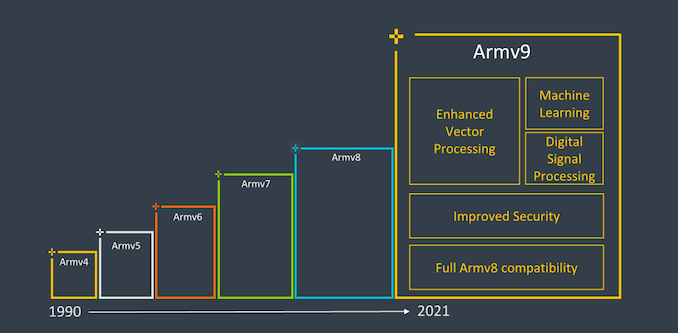
ARM’s brand new architecture comes almost a decade after the launch of ARMv8 in October 2011. ARMv8 brought support for 64-bit CPUs with the AArch64 instruction set. With ARMv9, the British semiconductor design firm aims to bring improved performance along with better security. The company says that its new design features enhanced vector processing, much better machine learning performance, improved security, digital signal processing, and full backward compatibility with ARMv8.

ARM v9 Architecture Features

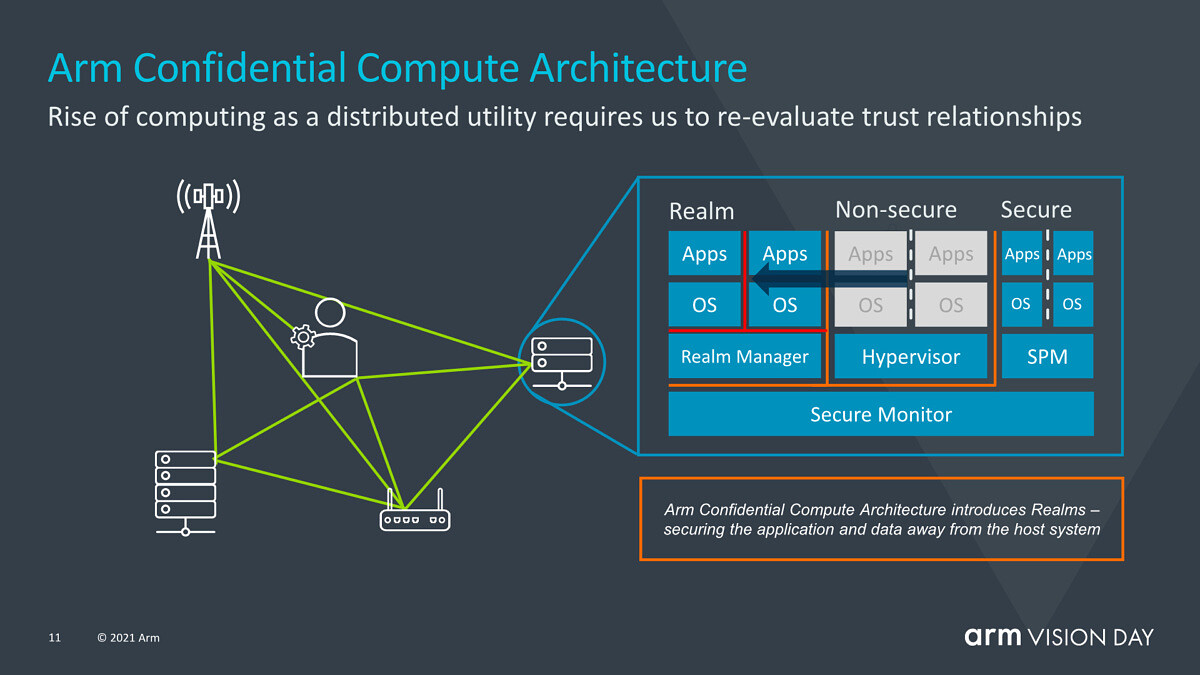
With ARMv9, smaller machine learning workloads can be processed directly on the CPU rather than relying on dedicated accelerators. It also introduces Confidential Compute Architecture (CCA) for a more dynamic security system. CCA creates ‘realms’ that are secure and containerized execution environments that are opaque to the operating system.

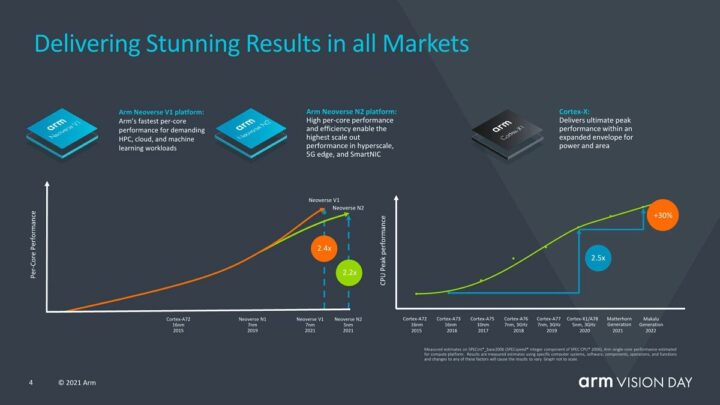
ARM claims that its new design brings an IPC (instructions per cycle) improvement of 30% over ARMv8, but AnandTech expects it to be around 14% better than current-generation CPUs such as the Cortex-A78 and Cortex-X1 (used in the Exynos 2100). ARM also revealed that its next-generation Mali GPUs will bring real-time ray-tracing and variable rate shading for improved graphics performance.

We can expect ARMv9-based processors from Apple, Samsung, Qualcomm, and MediaTek to hit the market sometime in 2022. So, it is possible that the Galaxy S22 will use a high-end Exynos processor with ARMv9-based CPU cores and AMD Radeon Mobile GPU. Samsung took a giant leap with the Exynos 2100, solving battery life and performance throttling issues, and the next-gen Exynos processor could be even better.

ARM v9 Confidential Compute Architecture

Min Goo Kim, executive vice president of SoC development at Samsung Electronics, said, “Arm’s next-generation Armv9 architecture offers a substantial improvement in security and machine learning, the two areas that will be further emphasized in tomorrow’s mobile communications devices. As we work together with Arm, we expect to see the new architecture usher in a wider range of innovations to the next generation of Samsung’s Exynos mobile processors.

ARM v9 Performance ARM Mali 2022 Features

The post Samsung vows to make Exynos processors based on ARM’s new architecture appeared first on SamMobile.


from SamMobile https://ift.tt/2PHvxui
via IFTTT

جميع الحقوق محفوظة لمدونة الغريب 2013